Harmonics Push Lasers Toward Record Intensities
Why It Matters
This breakthrough provides a practical route to achieve ultra‑intense light fields, enabling experiments that probe vacuum pair production and other strong‑field QED phenomena, with broad implications for fundamental physics and high‑energy laser applications.
Key Takeaways
- •CHF technique amplified laser intensity 80× beyond incident beam.
- •Harmonic conversion yielded 9.5 mJ across 12th‑47th orders.
- •Measured peak intensity reached 1.2 × 10²¹ W cm⁻².
- •Simulations suggest focused intensity >10²³ W cm⁻², approaching Schwinger limit.
- •Scalable to upcoming 10‑50 PW lasers for vacuum particle creation.
Pulse Analysis
Extreme‑light research has long been constrained by the diffraction limit, which caps how tightly a laser beam can be focused for a given wavelength. By converting the original beam into a cascade of shorter‑wavelength harmonics, physicists can shrink the focal spot and compress energy both spatially and temporally. This coherent harmonic focus (CHF) concept promises attosecond bursts with intensities far beyond conventional compression techniques, positioning it as a cornerstone for the next generation of high‑field experiments.
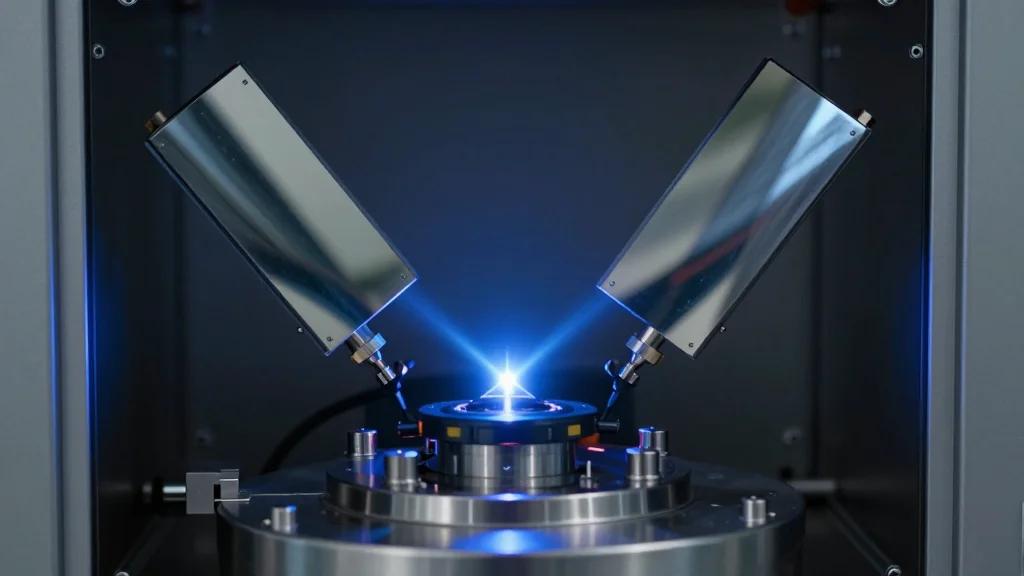
In the recent Oxford study, the team refined CHF by adding two plasma mirrors that sharpened the laser’s leading edge to a 350‑fs rise time. The resulting pulse, at 1.2 × 10²¹ W cm⁻², efficiently generated harmonics spanning the 12th to 47th orders and delivered roughly 9.5 mJ of extreme‑ultraviolet energy—three orders of magnitude above prior achievements. Spectral analysis confirmed a coherent, broadband harmonic beam, while simulations inferred a focused intensity surpassing 10²³ W cm⁻², a level previously unattainable in the laboratory.
Looking ahead, the scaling behavior of CHF suggests that forthcoming 10‑50 PW laser facilities could breach the Schwinger limit (≈10²⁹ W cm⁻²), where the vacuum itself becomes unstable and electron‑positron pairs materialize from pure light. Realizing this regime would unlock new tests of quantum electrodynamics, inform astrophysical models of extreme environments, and drive innovations in particle acceleration and high‑energy density science. The ability to harness such intensities also promises commercial spin‑offs in materials processing and medical imaging, underscoring the broader economic relevance of mastering coherent harmonic focusing.
Harmonics Push Lasers Toward Record Intensities
Comments
Want to join the conversation?
Loading comments...