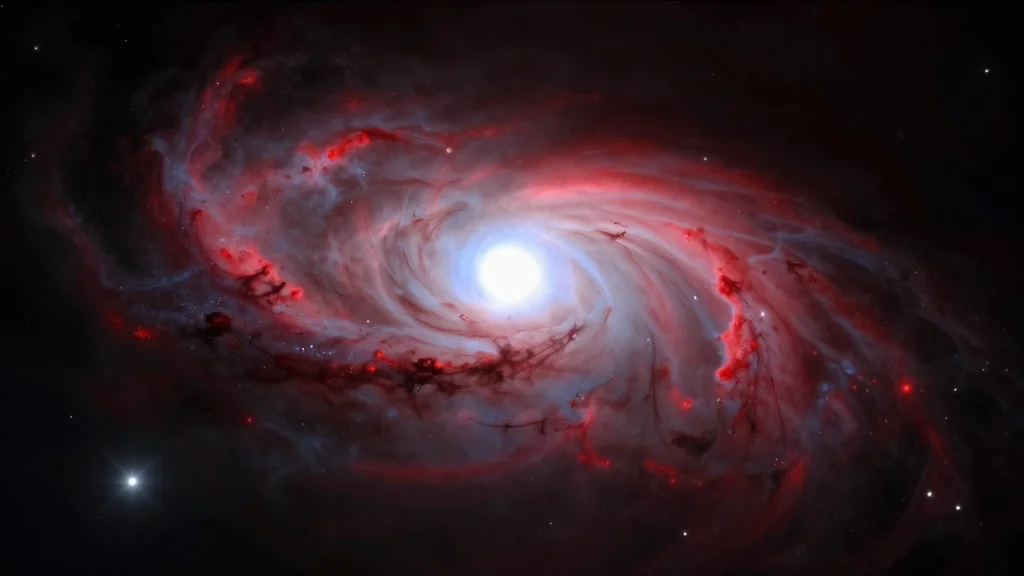
Heavily Reddened Quasars Caught Going Through a 'Blow-Out' Phase
Why It Matters
The findings provide the strongest observational evidence that heavily reddened quasars represent a transient, feedback‑driven stage in galaxy evolution, crucial for understanding how supermassive black holes grow and regulate star formation. This insight refines models of cosmic “noon” and informs future all‑sky surveys.
Key Takeaways
- •77 new heavily reddened quasars identified using SPHEREx infrared data
- •First seven HRQs at redshift >3, within 2.1 billion years after Big Bang
- •HRQs show depleted hot‑dust emission yet extreme intrinsic luminosities
- •UV excess in ~75% of HRQs suggests scattering or star formation
- •Results support a brief blow‑out phase clearing dust during black‑hole growth
Pulse Analysis
The discovery of heavily reddened quasars (HRQs) fills a long‑standing gap in our picture of galaxy evolution. Traditional optical surveys miss these dust‑enshrouded powerhouses, but infrared observatories like SPHEREx can pierce the veil, revealing objects that bridge the gap between the ultra‑obscured Hot DOGs and the classic blue quasars. By capturing the epoch when the universe was only 1.6–4.3 billion years old, the new sample offers a rare glimpse of black‑hole growth during cosmic noon, a period when star formation and accretion peaked across the cosmos.
SPHEREx’s all‑sky spectrophotometric capability allowed the research team to sift through millions of infrared sources and isolate 77 HRQs, more than doubling the known roster. Notably, seven of these lie at redshifts greater than 3, pushing the observational frontier to within the first 2.1 billion years after the Big Bang. After correcting for dust extinction, the quasars shine with intrinsic luminosities rivaling the brightest known active galactic nuclei, yet they emit surprisingly little hot‑dust infrared radiation. Approximately three‑quarters of the sample also display an ultraviolet excess, a signature that may arise from scattered quasar light or intense star‑forming regions within the host galaxy.
These characteristics bolster the “blow‑out” hypothesis: a brief, violent phase where radiation‑driven winds from the accreting supermassive black hole begin to expel surrounding dust, transitioning the system toward an unobscured blue quasar. Confirming this stage reshapes theoretical models of feedback‑regulated growth, influencing predictions of black‑hole mass assembly and galaxy quenching. The results also underscore the strategic value of wide‑field infrared missions for uncovering hidden populations, setting the stage for deeper follow‑up with JWST, Euclid, and future X‑ray observatories.
Heavily reddened quasars caught going through a 'blow-out' phase
Comments
Want to join the conversation?
Loading comments...