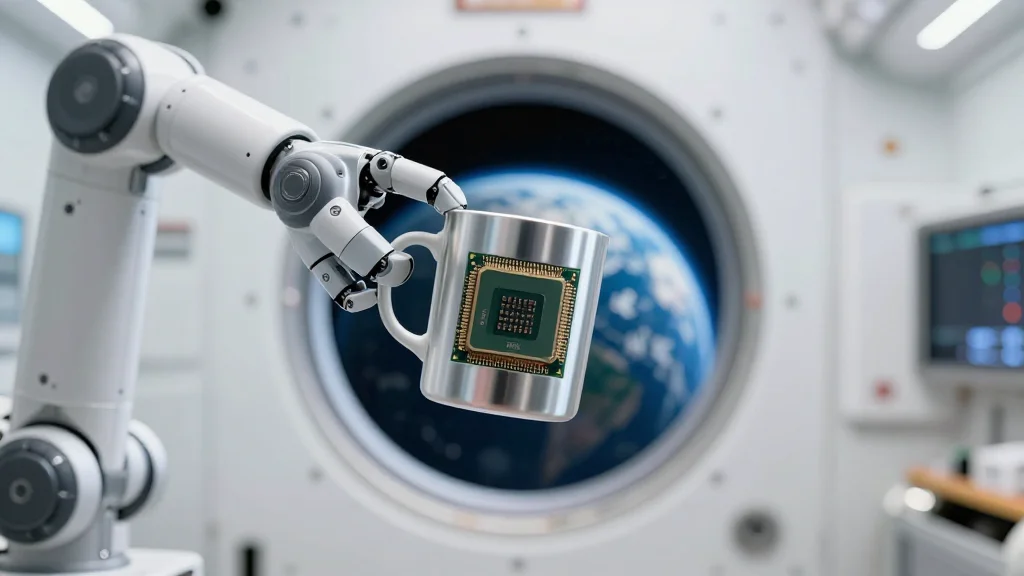
Hello Universe: NASA’s Next-Gen Space Processor Undergoes Testing
Why It Matters
The NGSP’s efficiency and resilience enable faster, AI‑driven decision‑making on distant probes, reducing reliance on Earth‑based control and lowering mission costs. Its compact form factor expands the payload options for upcoming Artemis and Mars exploration programs.
Key Takeaways
- •NGSP achieved 30% lower power draw than legacy processors.
- •Radiation testing validated tolerance up to 10 krad (Si).
- •Processing speed doubled, enabling real‑time AI onboard.
- •Design fits within 6‑U CubeSat form factor.
- •Supports Artemis, lunar gateway, and future Mars probes.
Pulse Analysis
Spacecraft today need more computing power than ever, yet the harsh radiation environment of deep space quickly degrades conventional electronics. NASA’s Next‑Gen Space Processor (NGSP) addresses this gap by marrying radiation‑hardening techniques with modern low‑power architectures. Compared with the agency’s older RAD750 and other heritage processors, the NGSP leverages advanced semiconductor materials and a streamlined instruction set, delivering higher throughput while consuming less energy—a critical advantage for missions where every watt counts.
During the latest test campaign at JPL’s Space Environment Simulation Laboratory, the NGSP endured a total ionizing dose of 10 krad (silicon), a level typical of multi‑year interplanetary voyages. The hardware maintained full operational capability, confirming its suitability for long‑duration missions. Performance benchmarks showed a two‑fold increase in processing speed, allowing on‑board artificial‑intelligence algorithms to analyze sensor data in real time. The processor’s power draw dropped by roughly 30% relative to its predecessor, extending battery life and enabling smaller power budgets for CubeSat‑class platforms.
The implications ripple across NASA’s upcoming initiatives. Artemis lunar landers and the Gateway orbital outpost can now host more sophisticated navigation and scientific analysis tools without overhauling existing power systems. Moreover, the NGSP’s 6‑U CubeSat footprint invites commercial partners to embed high‑performance computing into small‑sat missions, accelerating innovation in Earth observation and deep‑space exploration. As autonomy becomes a cornerstone of future spaceflight, the NGSP positions NASA—and its industry collaborators—to execute more complex missions with reduced latency and cost.
Hello Universe: NASA’s Next-Gen Space Processor Undergoes Testing
Comments
Want to join the conversation?
Loading comments...