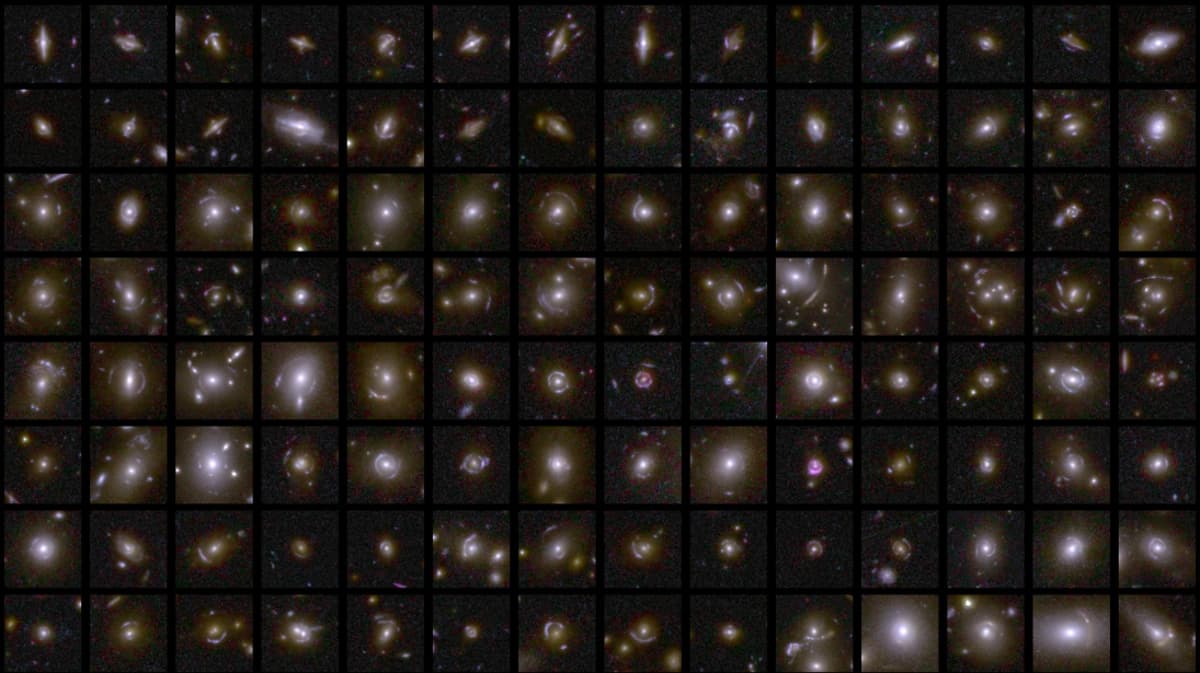
Help Scientists Find Spacetime Warps in These Euclid Space Telescope Images
Why It Matters
Gravitational lenses magnify distant galaxies and map dark‑matter distribution, so expanding the lens catalog accelerates cosmological research. Harnessing the public’s pattern‑recognition ability also improves AI tools that will process future astronomical big‑data surveys.
Key Takeaways
- •Euclid sends ~100 GB of data daily for analysis.
- •Space Warps shows 300,000 AI‑preselected images from 72 M galaxies.
- •Over 2,500 volunteers already classifying potential strong lenses.
- •Project aims to add >10,000 new lens candidates to catalogs.
- •Citizen classifications improve AI models for future astronomical surveys.
Pulse Analysis
The Euclid Space Telescope, launched in 2023, is redefining cosmology by mapping billions of galaxies across a wide swath of the sky. Its high‑resolution, wide‑field imaging generates an unprecedented data flow—about 100 GB per day—providing a fertile hunting ground for rare phenomena such as strong gravitational lenses. These natural telescopes bend and amplify light from background galaxies, offering a glimpse into the early universe and a direct probe of dark‑matter halos that would otherwise remain invisible.
Space Warps leverages the Zooniverse platform to turn this data deluge into a collaborative discovery engine. By presenting volunteers with 300,000 AI‑filtered snapshots, the project taps human visual intuition to spot subtle arcs and Einstein rings that algorithms may miss. Already, more than 2,500 citizen scientists have contributed classifications, and early results suggest the effort could add upwards of 10,000 new lens candidates to existing catalogs. This crowd‑sourced approach not only accelerates the identification pipeline but also generates high‑quality training sets for machine‑learning models, creating a feedback loop that refines future automated searches.
The scientific payoff extends beyond sheer numbers. Each newly identified lens serves as a natural magnifier, enabling astronomers to study galaxies at the edge of the observable universe and to map the distribution of both visible and dark matter with unprecedented precision. As Euclid continues its survey, the synergy between professional researchers, AI, and a global volunteer base exemplifies a new paradigm in big‑data astronomy—one where the public becomes an integral part of the discovery process, driving faster insights into the cosmos.
Help scientists find spacetime warps in these Euclid Space Telescope images
Comments
Want to join the conversation?
Loading comments...