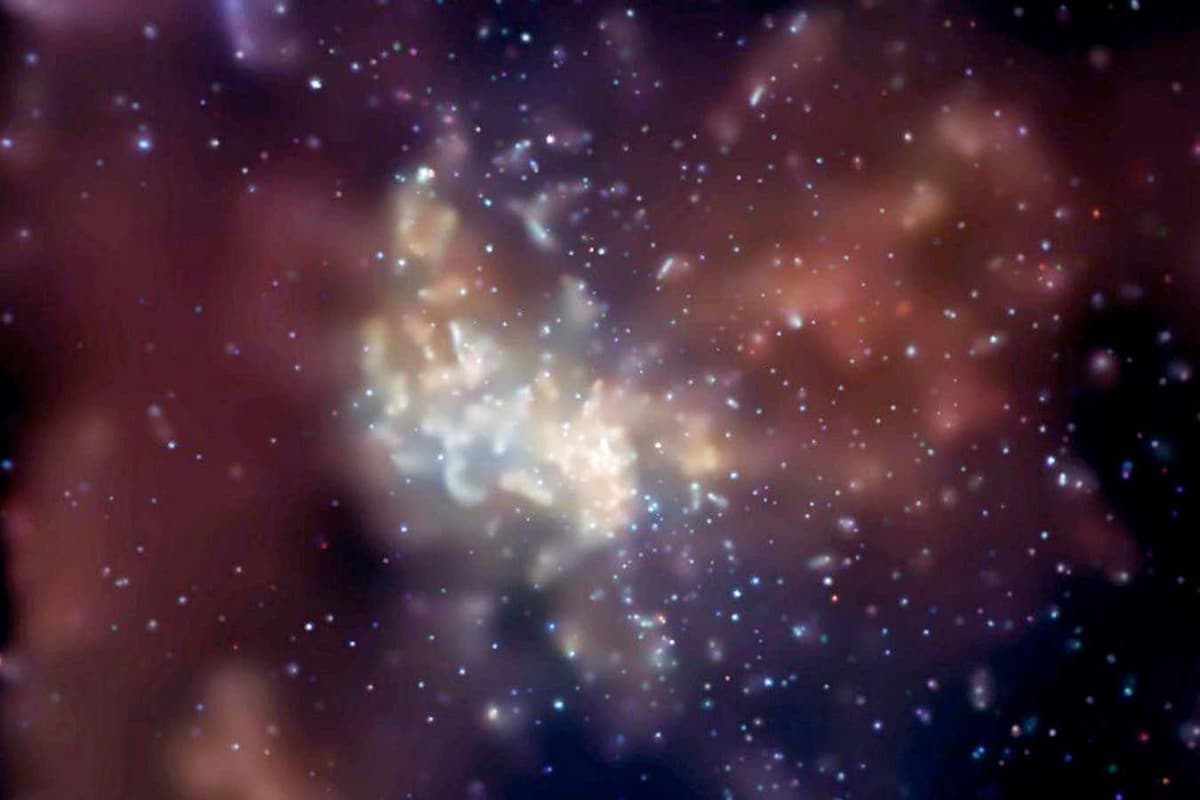
Hidden Black Hole Could Explain Mystery at the Heart of Our Galaxy
Why It Matters
If an intermediate‑mass black hole is identified, it would fill a critical gap in black‑hole demographics and reshape our understanding of how galactic nuclei evolve. The model offers a single, testable mechanism for the Milky Way’s most enigmatic stellar populations.
Key Takeaways
- •Intermediate-mass black hole (100–1,000 M☉) could shape central star dynamics
- •Model explains S‑stars, clockwise disc, and off‑disc populations simultaneously
- •Resonant interaction between the hidden black hole and Sagittarius A* tilts outer orbits
- •IRS‑13E cluster is the leading candidate for the unseen perturber
- •Detecting intermediate-mass black holes remains challenging due to limited observational signatures
Pulse Analysis
The Milky Way’s core has long puzzled astronomers with three distinct stellar families that share a common age yet occupy wildly different orbits. A new study from Xiaochen Zheng’s team proposes that a single intermediate‑mass black hole—roughly a few hundred to a thousand solar masses—lurking near Sagittarius A* can reconcile these anomalies. Such objects bridge the gap between stellar‑mass black holes and the supermassive monster at the galactic centre, and their existence would fill a missing rung in the black‑hole mass spectrum. If confirmed, the model would provide the simplest, unified explanation for the region’s chaotic architecture.
The proposed perturber exerts three gravitational ‘dances.’ First, its tilted orbit stretches the outermost stars, converting some into the off‑disc cohort that appears to orbit retrograde. Second, a resonance between the hidden black hole and Sagittarius A* nudges the clockwise disc stars into a thin, rotating plane without destabilising them. Finally, the innermost S‑stars remain largely untouched by the newcomer, their eccentric paths instead driven by mutual stellar encounters that carve out the observed zone of avoidance. This framework outperforms earlier hypotheses that required multiple, unrelated formation events.
Locating an intermediate‑mass black hole, however, is notoriously difficult. The only plausible beacon is the IRS‑13E stellar cluster, whose internal motions hint at a massive unseen core, yet the grouping could be a transient alignment. Upcoming facilities such as the James Webb Space Telescope, the Extremely Large Telescope, and next‑generation radio interferometers will deliver the astrometric precision needed to test the model. A confirmed detection would not only solve the Milky Way’s central mystery but also sharpen our understanding of black‑hole growth and galaxy‑scale dynamics across the cosmos.
Hidden black hole could explain mystery at the heart of our galaxy
Comments
Want to join the conversation?
Loading comments...