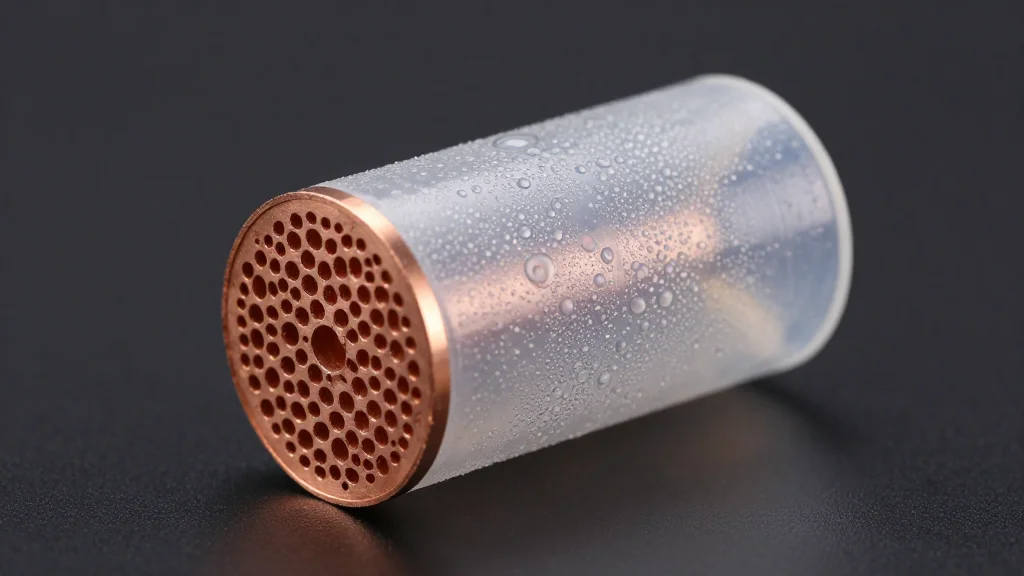
Hierarchically Biporous Wick Vapor Chamber With Micro/Nano Condenser for Exceeding 600 W/Cm2 Heat Dissipation
Why It Matters
The ability to manage extreme heat fluxes expands design freedom for AI processors, data‑center modules, and power‑dense automotive electronics, where thermal limits currently curb performance and reliability.
Key Takeaways
- •Hierarchical biporous copper wick boosts capillary flow while preserving permeability
- •Superhydrophobic nano‑textured condenser enables dropwise condensation and rapid return
- •Thermal resistance reaches 0.17 °C/W, supporting >600 W/cm² heat flux
- •Operates under gravity‑opposed conditions, widening layout possibilities
Pulse Analysis
Thermal management has become a bottleneck as semiconductor architectures push toward higher power densities. Traditional vapor chambers rely on porous wicks that must balance capillary pressure against fluid permeability; exceeding a few hundred watts per square centimeter often starves the evaporator of liquid, causing temperature spikes. The new design sidesteps this limitation by employing a hierarchically biporous copper wick that offers a multi‑scale pore network, delivering strong capillary suction without sacrificing flow conductance. Coupled with a superhydrophobic condenser engineered at the micro‑ and nano‑scale, the system promotes dropwise condensation, dramatically reducing interfacial thermal resistance and accelerating condensate return to the wick.
Beyond the laboratory, this technology addresses real‑world challenges in high‑performance computing and edge AI. Modern GPUs and AI accelerators can generate localized heat fluxes well above 400 W/cm², forcing designers to resort to bulky heat sinks or active liquid cooling loops. A vapor chamber that reliably handles 600 W/cm² while maintaining a thermal resistance of 0.17 °C/W enables slimmer form factors and higher integration densities, potentially reducing system cost and power consumption. Moreover, its ability to function when the condenser is positioned above the heat source eliminates the need for gravity‑dependent layouts, granting engineers greater flexibility in compact devices such as autonomous‑vehicle power modules and 5G base stations.
The broader market impact could be significant. As data centers scale to meet AI workloads, incremental improvements in cooling efficiency translate into measurable energy savings and lower carbon footprints. Automotive electrification, too, demands compact, high‑flux cooling solutions for power‑train inverters and battery management systems. By delivering a self‑sustaining, low‑resistance vapor chamber, the research paves the way for next‑generation thermal solutions that keep pace with the relentless rise in electronic power density. Companies that adopt this architecture early may gain a competitive edge in reliability and performance.
Hierarchically Biporous Wick Vapor Chamber With Micro/Nano Condenser for Exceeding 600 W/cm2 Heat Dissipation
Comments
Want to join the conversation?
Loading comments...