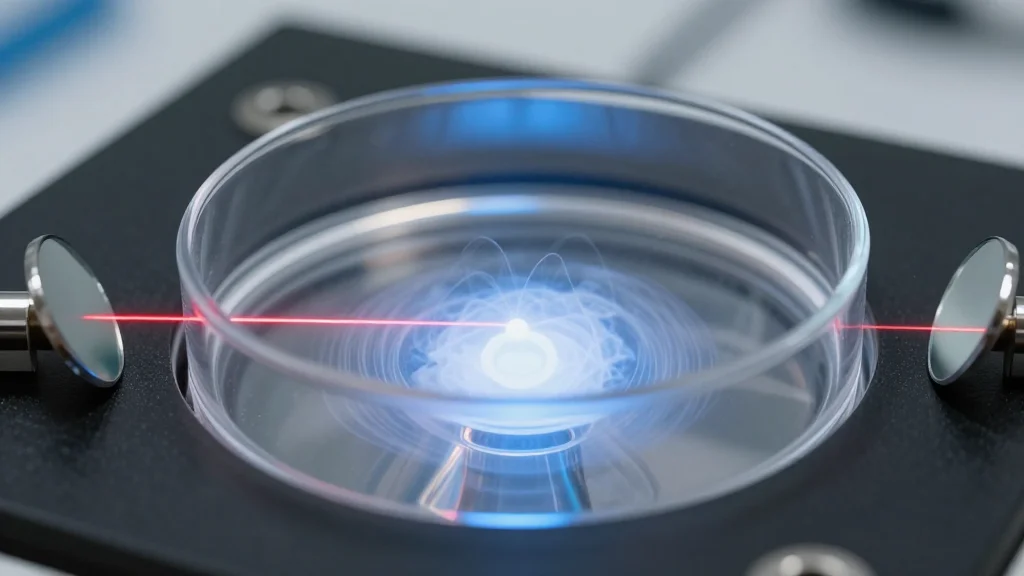
High-Resolution Imaging Captures Cavity-Induced Density Waves in a Quantum Gas
Why It Matters
Direct imaging validates theoretical models of long‑range photon‑mediated interactions and accelerates the design of engineered quantum materials. It gives experimentalists a powerful tool to explore emergent phases in cavity QED platforms.
Key Takeaways
- •First high‑resolution, in‑situ images of cavity‑induced density waves
- •Microscopy links atom density patterns to real‑time cavity photon signals
- •Infinite‑range interactions dominate over kinetic and thermal energies
- •Technique can be adapted to image magnetization and pairing in quantum gases
Pulse Analysis
Cavity quantum electrodynamics (QED) has become a cornerstone for engineering exotic many‑body states, but its hallmark—long‑range photon‑mediated interactions—has largely been inferred from indirect observables such as leaked photons or Bragg scattering. The recent observation of a superradiant phase transition in a unitary Fermi gas underscores how collective light‑matter coupling can overcome kinetic, thermal, and interaction energy scales, driving atoms into a periodic density‑wave pattern that mirrors the standing‑wave mode of the optical cavity.
The breakthrough comes from a custom high‑numerical‑aperture microscope that fuses single‑shot absorption imaging with simultaneous cavity‑photon readout. By illuminating the gas with a pump laser and capturing the attenuated probe beam, researchers mapped density correlations in real time, while photon detection provided a non‑destructive gauge of the evolving order. This dual‑channel approach not only visualized the spatial structure of the density wave but also quantified atom‑field correlations, confirming the infinite‑range nature of the interaction and revealing a uniform phase across the entire cloud.
Beyond confirming long‑standing theoretical predictions, the technique paves the way for probing richer quantum phenomena. Extending the method to image spin‑dependent magnetization or Cooper‑pairing patterns could unlock direct studies of quantum magnetism and unconventional superconductivity in engineered light‑matter platforms. For the broader quantum‑technology sector, such high‑resolution diagnostics accelerate the development of tunable quantum simulators and may inform future photonic‑based quantum processors where precise control of many‑body states is essential.
High-resolution imaging captures cavity-induced density waves in a quantum gas
Comments
Want to join the conversation?
Loading comments...