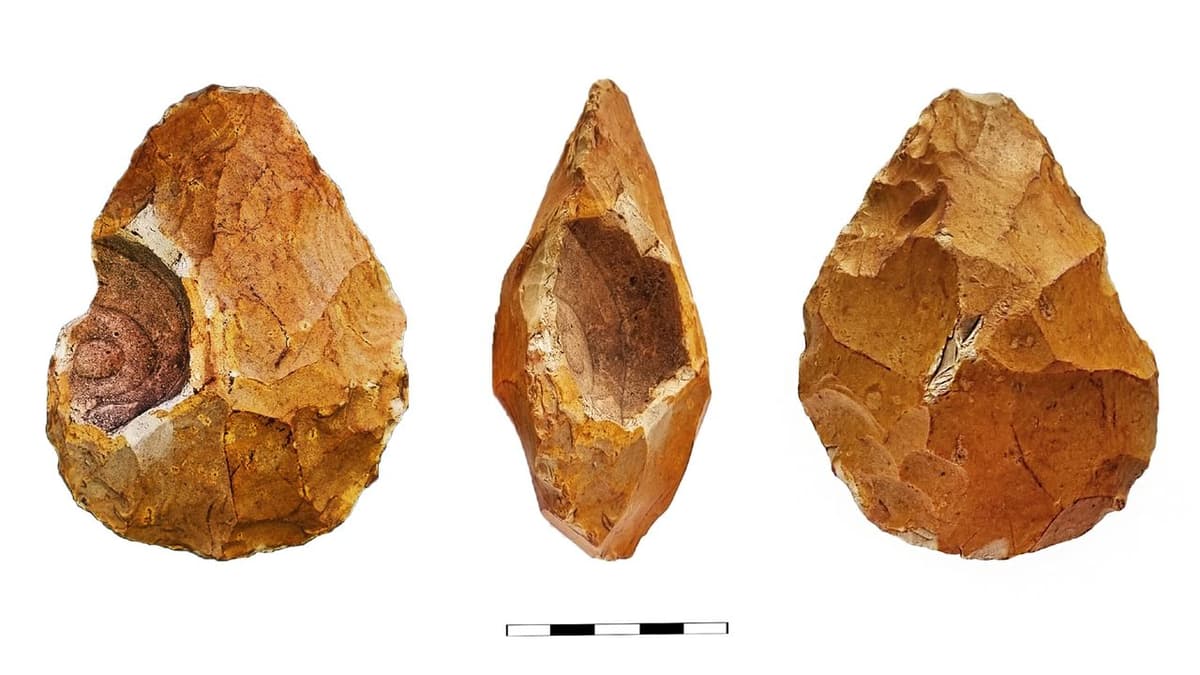
Homo Erectus' Tools Include Stunning Geodes and Fossils, Possibly as a Way to Connect with the Cosmos, Study Finds
Why It Matters
If Homo erectus purposefully embedded fossils in tools, it pushes back the emergence of symbolic cognition and suggests early humans sought spiritual connections with the landscape, reshaping narratives of cultural evolution.
Key Takeaways
- •Ten hand axes contain fossils, geodes, or hollow features.
- •Tools date to 500‑200 k years, linked to Homo erectus.
- •Researchers view inclusion as deliberate, hinting at symbolic intent.
- •Largest concentration of such artifacts challenges view of purely utilitarian tools.
Pulse Analysis
The recent identification of ten hand axes from Israel’s Sakhnin Valley, each carved around fossils, geodes, or natural hollows, adds a striking new layer to our picture of Homo erectus cognition. Dated between half a million and two hundred thousand years ago, these artifacts are not merely functional but appear to have been selected for their visual and perhaps metaphysical qualities. Such intentionality suggests that early hominins possessed a capacity for symbolic thought far earlier than the Upper Paleolithic, challenging the long‑held view that abstract cognition emerged only with modern humans.
These finds stand out against a backdrop of isolated, singular examples reported from Africa, Europe, and Asia, making the Sakhnin assemblage the largest known cluster of geode‑bearing tools. The researchers’ argument rests on the added brittleness and extra labor required to work around embedded fossils, implying a purpose beyond efficiency. Critics, however, caution that accidental inclusion cannot be ruled out without contextual stratigraphy. Ongoing debates echo earlier controversies over ochre use and engraved shells, underscoring the need for rigorous taphonomic analysis to separate symbolism from serendipity.
If the symbolic interpretation holds, it reshapes narratives about the ‘holy triad’ of stone, water, and megafauna that underpinned early subsistence strategies, positioning cosmological meaning as a parallel driver of technology. Future excavations at deeper levels of the valley, coupled with micro‑use‑wear studies and residue analysis, could reveal whether these tools served ritualistic functions or were merely status symbols. Ultimately, the discovery invites a broader reassessment of how prehistoric peoples perceived their environment, suggesting that the impulse to embed meaning in material culture is a deep‑rooted human trait.
Homo erectus' tools include stunning geodes and fossils, possibly as a way to connect with the cosmos, study finds
Comments
Want to join the conversation?
Loading comments...