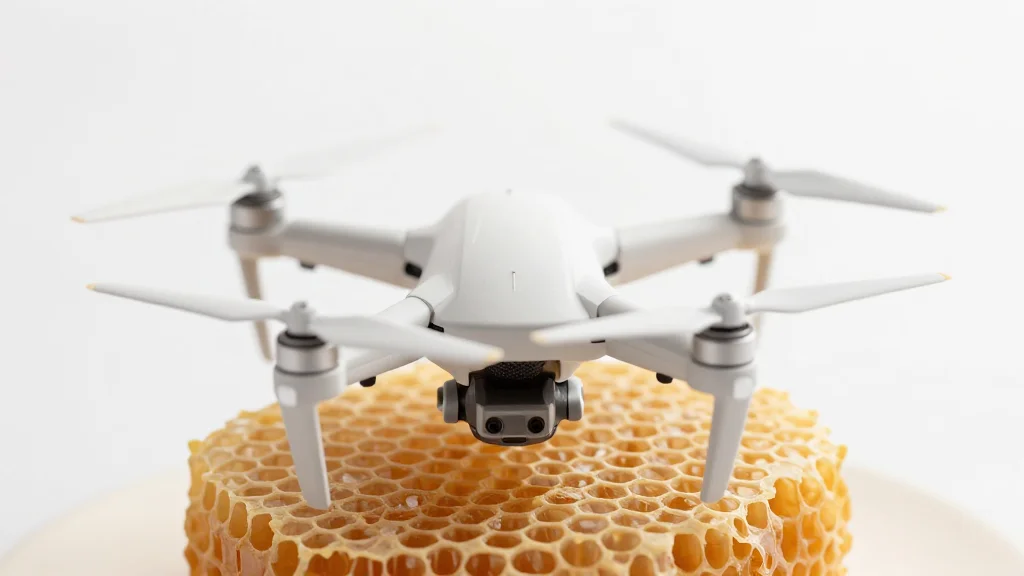
Honeybees Inspire a Super-Efficient Navigation System for Drones
Why It Matters
Bee‑Nav dramatically cuts the computational and energy load of autonomous flight, opening new markets for micro‑drones in agriculture, logistics, and disaster response where traditional SLAM solutions are impractical.
Key Takeaways
- •Bee‑Nav uses 42 KB neural network for GPS‑free drone homing.
- •Learning flight captures panoramic images to create visual odometry cues.
- •System succeeds indoors over 600 m; outdoor success drops to ~70% in wind.
- •Enables ultra‑light UAVs for greenhouse, warehouse, and GPS‑denied missions.
Pulse Analysis
The robotics community has long wrestled with the trade‑off between navigation accuracy and onboard resource constraints. Conventional solutions such as GPS‑assisted flight or simultaneous localization and mapping (SLAM) demand high‑resolution sensors, powerful processors, and sizable memory banks—luxuries that small unmanned aerial vehicles (UAVs) cannot afford. By turning to nature’s own efficiency, engineers are discovering alternatives that sidestep these bottlenecks, allowing drones to operate in GPS‑denied environments with minimal hardware.
Bee‑Nav translates the honeybee’s two‑step strategy—brief learning flights followed by odometry‑based homing—into a compact artificial‑intelligence pipeline. During the initial sweep, the drone records panoramic snapshots of its surroundings, which a tiny neural network (as little as 3.4 KB for indoor demos) later interprets to estimate direction and distance back to the launch point. The system tolerates the drift inherent in odometry by anchoring visual cues, achieving reliable indoor returns over 600 m and maintaining roughly a 70% success rate outdoors despite wind‑induced visual distortion. This performance underscores that precise mapping is not a prerequisite for safe navigation when visual memory is leveraged intelligently.
The commercial implications are significant. Ultra‑light UAVs equipped with Bee‑Nav can infiltrate dense greenhouse rows, navigate cluttered warehouses, or scout disaster zones where GPS signals are blocked, all while conserving battery life and reducing payload weight. Moreover, the approach scales to swarms, where each unit can operate autonomously without centralized processing. Future research will likely focus on enhancing robustness to environmental variability and integrating the method with other sensor modalities, potentially redefining the design paradigm for next‑generation autonomous drones.
Honeybees inspire a super-efficient navigation system for drones
Comments
Want to join the conversation?
Loading comments...