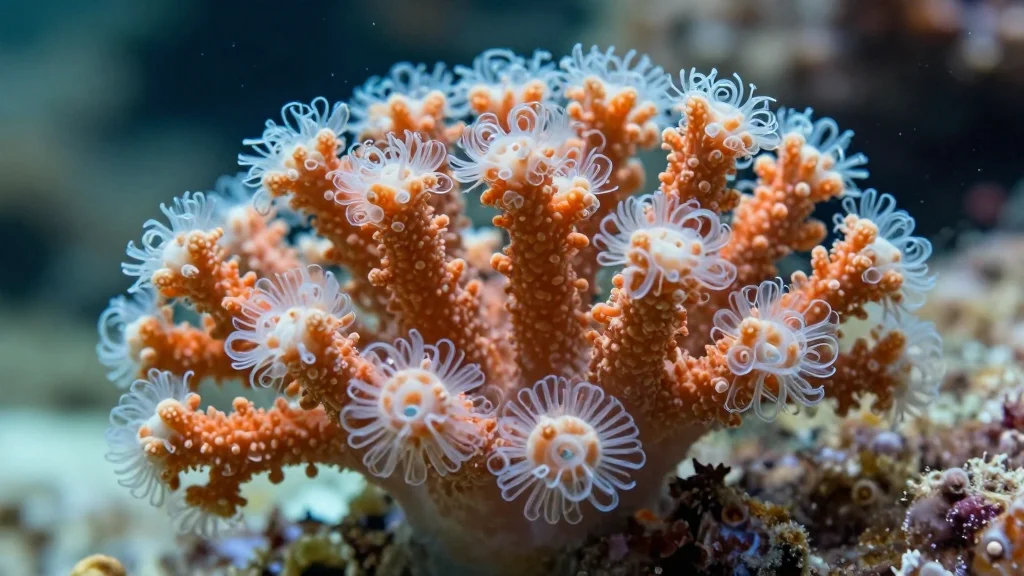
Why It Matters
Understanding coral‑driven flows unlocks new strategies for reef health monitoring and inspires bio‑engineered fluid systems, directly impacting marine biotech and climate‑resilience investments.
Key Takeaways
- •Rotlet model captures 3D coral ciliary flows better than continuum approaches
- •Model predicts vertical transport zones that enhance nutrient exchange
- •Findings aid design of bio‑inspired microfluidic mixers
- •Improved flow understanding supports coral health monitoring technologies
- •Framework applicable to other ciliated organisms and engineered surfaces
Pulse Analysis
The recent rotlet‑based framework marks a paradigm shift in marine biophysics, moving beyond averaged continuum models to a discrete, torque‑driven description of ciliary carpets. By aligning theoretical predictions with high‑resolution tracer‑particle measurements from Great Barrier Reef specimens, the researchers demonstrate how hexagonal cilia arrangements generate robust three‑dimensional vortices that stir seawater, disrupt diffusive boundary layers, and accelerate oxygen and nutrient delivery to coral polyps. This mechanistic insight clarifies long‑standing questions about coral metabolism and resilience under stress.
For the technology sector, the study offers a blueprint for bio‑inspired fluid engineering. Rotlet dynamics can be translated into microfluidic mixers that mimic coral’s efficient vertical transport, enabling faster chemical reactions and improved particle separation in lab‑on‑a‑chip devices. Moreover, the ability to predict flow patterns from ciliary geometry opens avenues for designing smart surfaces that regulate heat, mass, or light transfer in aerospace and renewable‑energy applications. Companies investing in biomimetic solutions now have a validated physics model to accelerate product development.
Looking ahead, the model’s scalability positions it as a core tool for ecological monitoring platforms. Integrating rotlet‑based flow predictions with autonomous underwater sensors could provide real‑time assessments of reef health, informing conservation policies and carbon‑credit schemes tied to marine ecosystem services. The interdisciplinary collaboration—spanning physics, biology, and engineering—highlights the commercial potential of fundamental research, encouraging venture capital to fund further exploration of active‑matter systems across marine and industrial domains.
How Corals Stir Seawater
Comments
Want to join the conversation?
Loading comments...