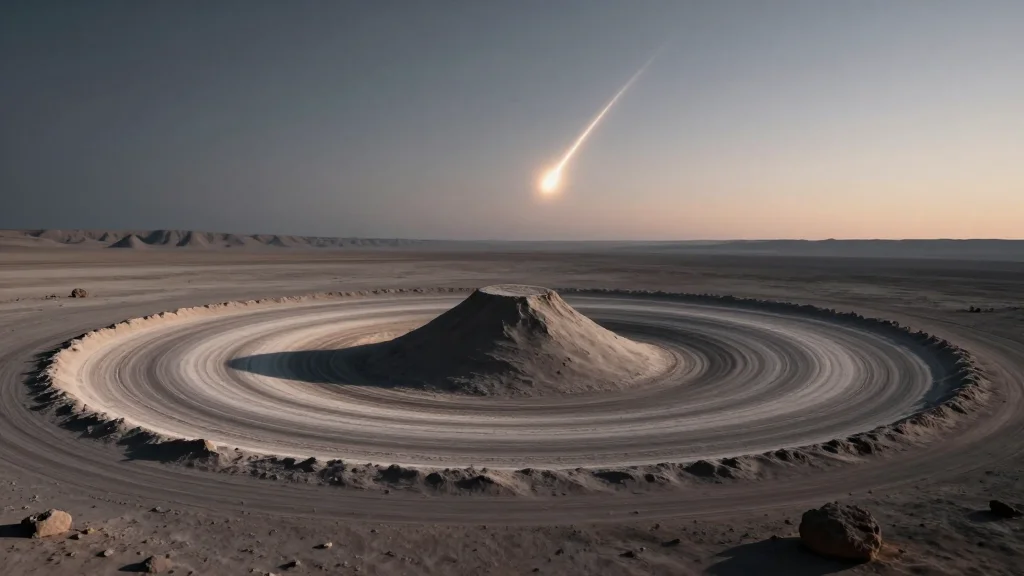
How Dante's Inferno Modeled a Planetary Impact 500 Years Before Modern Science
Why It Matters
The study bridges literature and planetary science, suggesting ancient narratives can inform modern impact‑risk assessment and defense strategies. It highlights how interdisciplinary analysis can uncover hidden scientific insights in cultural artifacts.
Key Takeaways
- •Burbery links Satan’s fall to an asteroid‑size impact in Dante’s Inferno.
- •Impact model parallels Chicxulub crater’s size and central‑peak formation.
- •Nine circles of Hell mirror multi‑ring basins seen on Moon and Venus.
- •Study suggests literary works can inform modern planetary‑defense strategies.
- •Research presented at EGU General Assembly 2026, sparking interdisciplinary debate.
Pulse Analysis
The reinterpretation of Dante’s *Inferno* as a gedankenexperiment in impact physics marks a bold crossover between medieval literature and contemporary meteoritics. Burbery’s analysis treats Satan’s fall not as a purely symbolic act but as a high‑velocity asteroid striking the Southern Hemisphere, carving a crater whose geometry echoes the multi‑ring basins that dominate planetary surfaces. By aligning the poem’s nine circles with the terraced morphology of impact basins, the research offers a fresh lens through which scholars can examine how early thinkers intuitively grasped concepts later formalized by modern science.
Scientifically, the proposed scenario draws striking parallels to the Chicxulub event that triggered the Cretaceous‑Paleogene extinction. Both involve an oblong impactor that penetrates deep enough to generate a central peak—represented in the poem by Mount Purgatory—and a surrounding ejecta pattern akin to the circles of Hell. The comparison extends to the Hoba meteorite’s intact mass, reinforcing the notion that Dante imagined a solid, non‑vaporized body reshaping Earth’s crust. This literary‑geophysical analogy underscores the universality of impact dynamics, from lunar basins to Venusian plains, and demonstrates how narrative structures can mirror physical processes.
Beyond academic curiosity, the findings carry practical implications for planetary‑defense initiatives. By showcasing how a 14th‑century text encodes accurate impact mechanics, the study encourages policymakers to consider cultural artifacts as untapped reservoirs of public awareness about extraterrestrial threats. Integrating literary geomythology into outreach could enhance societal resilience and support funding for asteroid detection programs. As the scientific community continues to refine impact‑risk models, interdisciplinary collaborations like Burbery’s may prove vital in shaping a more informed and prepared global response.
How Dante's Inferno modeled a planetary impact 500 years before modern science
Comments
Want to join the conversation?
Loading comments...