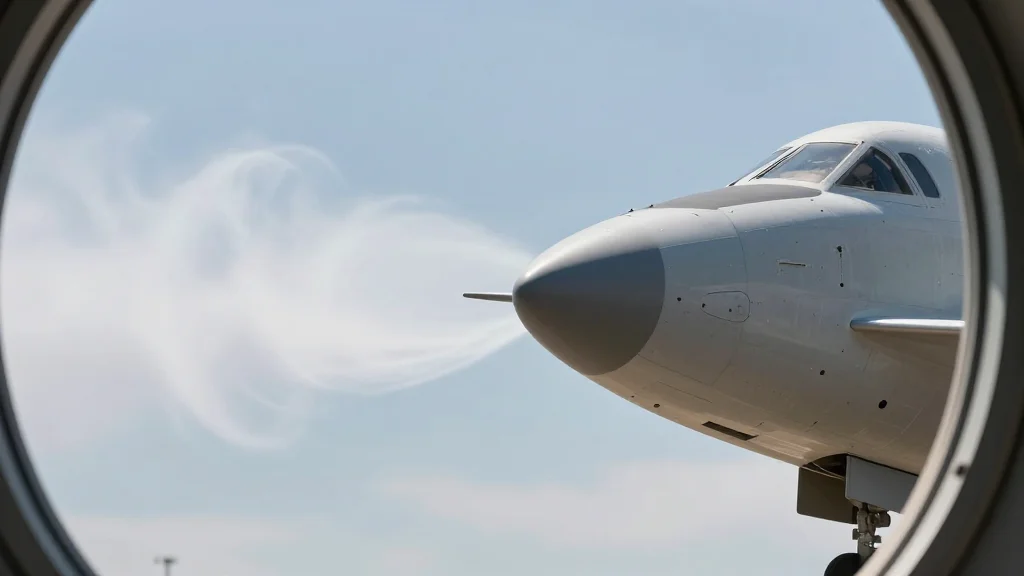
How Flight Angles Influence Turbulence and Vortex Formation: Insights From FAMU-FSU Researchers
Why It Matters
Understanding angle‑dependent vortex asymmetry directly informs aircraft stability, enabling safer high‑speed maneuvering and expanding operational envelopes for both military and commercial aerospace platforms.
Key Takeaways
- •Vortices shift from symmetric spirals at 15° to dominant asymmetry at 25°‑30°
- •Asymmetric breakdown creates uneven lateral forces, risking yaw and roll
- •Findings enable predictive operational envelopes for supersonic conical forebodies
- •Research supports AI‑driven real‑time flow control for future hypersonic vehicles
Pulse Analysis
The FAMU‑FSU team’s investigation into vortex dynamics tackles a long‑standing challenge in high‑speed aerodynamics: how minute changes in an aircraft’s angle of incidence can destabilize airflow. By coupling wind‑tunnel experiments with high‑resolution computational fluid dynamics, the researchers captured the evolution of vortex structures on a conical forebody at Mach 1.1. Their data reveal a clear bifurcation point where the flow transitions from orderly, dual‑spiral patterns at modest angles to a single, chaotic vortex at steeper pitches, exposing the mechanisms behind vortex breakdown and asymmetry.
These insights have immediate design implications. Asymmetric vortices impose uneven pressure distributions, generating lateral forces that can induce unwanted yaw or roll moments. Engineers can now incorporate predictive models into the early stages of aircraft and missile design, defining safe angle‑of‑attack limits and tailoring adaptive control surfaces—such as morphing flaps or active suction panels—to counteract destabilizing flows. By establishing a more accurate operational envelope, manufacturers can improve fuel efficiency, reduce structural fatigue, and enhance mission reliability for supersonic platforms.
Looking ahead, the research paves the way for intelligent flow‑control systems that leverage artificial intelligence and real‑time sensor data to detect incipient vortex asymmetry and deploy corrective actions autonomously. Extending the study into transonic and hypersonic regimes promises to unlock further performance gains for next‑generation vehicles. Moreover, the project serves as a training ground for emerging aerospace engineers, equipping them with cutting‑edge simulation tools and a deeper grasp of fluid‑structure interactions essential for the future of high‑velocity flight.
How Flight Angles Influence Turbulence and Vortex Formation: Insights from FAMU-FSU Researchers
Comments
Want to join the conversation?
Loading comments...