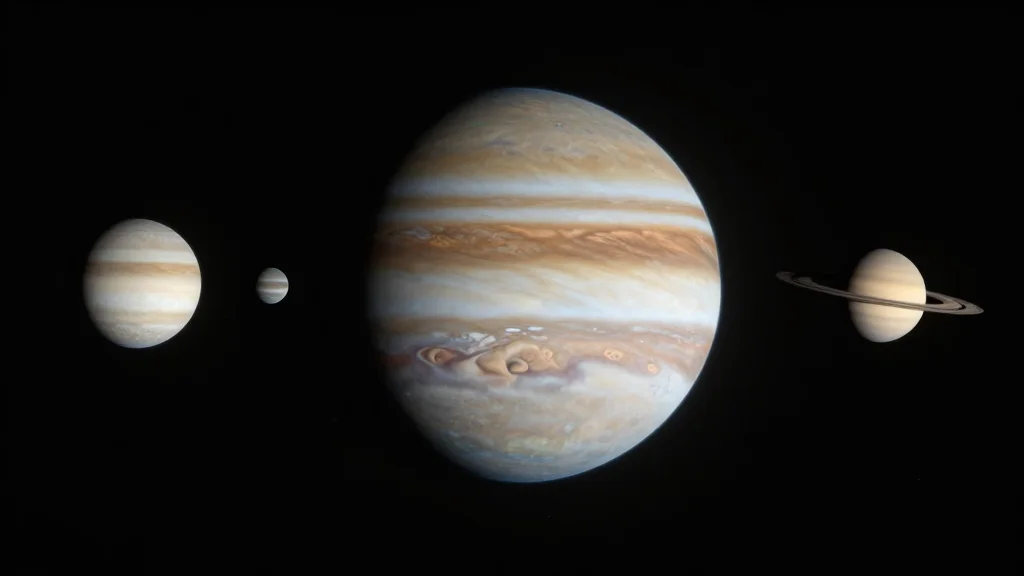
How Jupiter Cultivated More Large Moons Than Saturn
Why It Matters
Understanding the divergent moon systems of Jupiter and Saturn refines planetary formation models, aiding predictions for exoplanetary moons and their habitability potential.
Key Takeaways
- •Jupiter's massive circumplanetary disk allowed formation of multiple large moons
- •Saturn's slower gas accretion limited material for moon growth
- •Orbital resonances stabilized Jupiter's moon system, preventing collisions
- •Migration of Jupiter's moons captured additional icy bodies from outer disk
- •Findings refine models of exoplanet satellite formation
Pulse Analysis
The research overturns the long‑standing assumption that Saturn’s iconic rings imply a richer satellite environment. By reconstructing the early gas‑giant accretion phases, the Kyoto team showed that Jupiter’s circumplanetary disk contained roughly twice the solid mass of Saturn’s, providing the raw material for four Galilean‑size moons to coalesce. This abundance of building blocks, combined with rapid cooling, allowed the moons to reach sizes comparable to Earth’s moon before the gas dissipated, setting a benchmark for satellite formation in massive disks.
A second key insight involves orbital dynamics. Jupiter’s moons entered a chain of mean‑motion resonances early on, which locked their orbits into a stable configuration. These resonances damped eccentricities, reducing collision risk and preserving the moons’ integrity over billions of years. Saturn, lacking a similarly massive disk, never achieved the same resonant architecture, leading to a more fragmented and smaller moon system. The study’s simulations demonstrate how resonance capture can act as a protective mechanism for nascent satellites.
The broader implications extend to exoplanet science. Gas giants discovered around other stars often reside in protoplanetary disks with varying mass distributions. Applying Jupiter’s formation pathway suggests that massive disks are likely to spawn sizable moon systems, potentially detectable with next‑generation telescopes. Conversely, smaller disks may yield only dwarf satellites, influencing the habitability prospects of exomoons. By linking disk mass, accretion speed, and resonant dynamics, the findings provide a more nuanced framework for predicting moon populations beyond our solar system.
How Jupiter Cultivated More Large Moons Than Saturn
Comments
Want to join the conversation?
Loading comments...