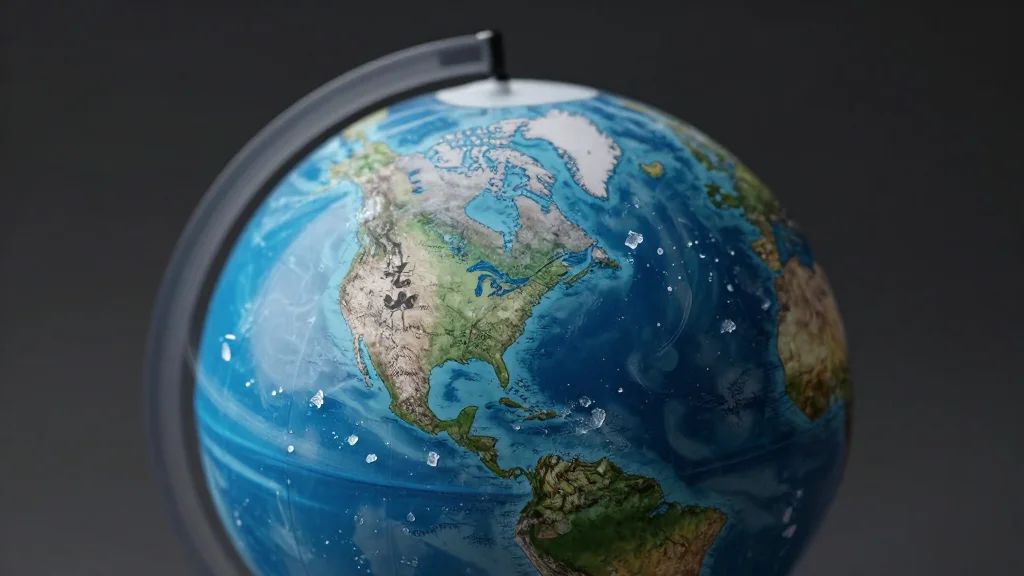
How Melting Ice Sheets Are Adding More Time to Your Day
Why It Matters
Faster day‑lengthening forces more frequent leap‑second corrections, threatening time‑sensitive systems and precise navigation. It also provides a tangible metric of how climate change reshapes Earth’s physical behavior.
Key Takeaways
- •Days lengthen 1.33 ms per century, fastest in 3.6 M years
- •Melting ice shifts mass toward equator, increasing Earth's oblateness
- •Deep‑learning model reconstructs rotation changes from fossils and corals
- •Accelerated LOD may demand more frequent leap‑second adjustments
Pulse Analysis
The Earth’s rotation is not a static clockwork; it responds to mass redistribution across the planet. As global temperatures rise, ice sheets and mountain glaciers melt, adding water to the oceans and moving mass toward the equator. This redistribution makes the planet slightly more oblate—flattened at the poles and bulged at the equator—causing the rotation to slow and the length of day (LOD) to increase. While the change is measured in milliseconds, the underlying physics mirrors the classic ice‑skater analogy, where extending the arms slows a spin.
Researchers led by Mostafa Kiani Shahvandi applied a deep‑learning framework to noisy paleoclimatic records from fossils and coral reefs, reconstructing LOD fluctuations over millions of years. Their model identified a modern acceleration of 1.33 milliseconds per century, the highest rate in 3.6 million years, eclipsing the only comparable episode around two million years ago. Historically, ice‑sheet growth and melt produced LOD swings of 10‑30 milliseconds, but those shifts unfolded over geological timescales, making the current rapid pace uniquely anthropogenic.
The practical implications extend beyond academic curiosity. A faster‑lengthening day widens the gap between astronomical time and atomic clocks, potentially requiring more frequent leap‑second insertions to keep global time standards aligned. Such adjustments can disrupt computer networks, satellite navigation, and high‑frequency trading platforms that rely on precise 24‑hour cycles. Although the amplitude remains too small to alter ocean circulation, the study underscores a concrete, measurable impact of climate change on Earth’s fundamental physical processes, reinforcing the urgency of mitigation efforts.
How melting ice sheets are adding more time to your day
Comments
Want to join the conversation?
Loading comments...