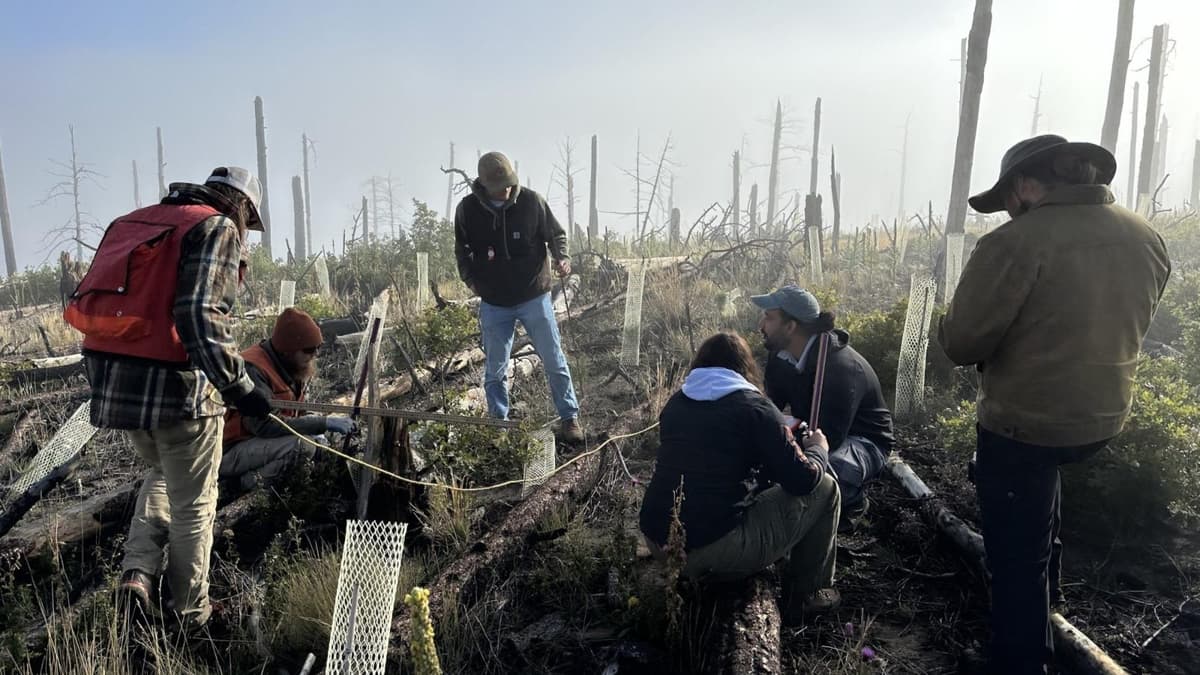
How New Mexico Is ‘Building a Forest’ by Solving a Seedling Shortage
Why It Matters
Accelerating native reforestation restores critical watershed protection and reduces long‑term water scarcity in the Southwest, while creating a scalable model for climate‑resilient forest recovery across fire‑prone regions.
Key Takeaways
- •New Mexico Reforestation Center will triple seedling output to 5 million annually
- •Hermit’s Peak‑Calf Canyon Fire needs 17.6 million seedlings for recovery
- •Existing nurseries produce ~250,000 seedlings, far below state’s 385 million‑tree backlog
- •Researchers use drought‑conditioning and shade techniques to boost seedling survival
- •Greenhouses will total 155,000 sq ft, creating a regional seed hub
Pulse Analysis
Wildfires have scarred 7 million acres of New Mexico since 2000, leaving watersheds exposed and communities vulnerable to flash floods and contaminated drinking water. Forests act as natural water infrastructure, capturing snowpack and rainfall that supplies roughly 70 percent of the state’s water use. Replanting burned hillsides is therefore not just an ecological priority but a public‑health imperative. The Hermit’s Peak‑Calf Canyon fire, the largest in state history, illustrates the scale of the challenge, requiring an estimated 17.6 million seedlings to restore the landscape and stabilize the water cycle.
The New Mexico Reforestation Center, a partnership among the state Forestry Division, UNM, NMSU and NMHU, is poised to transform the reforestation pipeline. Its upcoming greenhouse complex will expand production capacity from a modest 250,000 seedlings per year to an ambitious 5 million, more than enough to begin closing the 385 million‑tree backlog. Beyond sheer volume, the center integrates cutting‑edge research: UNM models seedling survival under 2100 climate scenarios, while NMSU applies drought‑conditioning and strategic shade planting to harden seedlings against future heat and aridity. These science‑driven methods aim to ensure that each sapling is genetically suited to its elevation and climate, improving long‑term forest resilience.
The initiative’s impact extends beyond New Mexico’s borders. By generating regionally adapted stock, the center can supply neighboring Four Corners states, fostering a collaborative Southwest reforestation network that currently operates in silos. Economic benefits include new jobs in greenhouse operations, seed processing and field monitoring, while community outreach—such as school workshops that connect students to the seed‑to‑tree journey—builds local stewardship. In a climate era where wildfires are becoming the new normal, New Mexico’s greenhouse‑driven strategy offers a replicable blueprint for turning post‑fire devastation into a sustainable, water‑secure future.
How New Mexico is ‘building a forest’ by solving a seedling shortage
Comments
Want to join the conversation?
Loading comments...