How Often Does Earth Transit the Sun for an Observer on Mars?
•March 9, 2026
0
Why It Matters
Earth transits provide a rare observational benchmark for future Mars explorers and highlight the precise orbital mechanics linking the two planets. They also offer a powerful visual reminder of the vast distance between Earth and Mars for both scientists and the public.
Key Takeaways
- •Earth transits Mars every 284 years
- •Four transits per cycle: 100.5, 79, 25.5, 79-year gaps
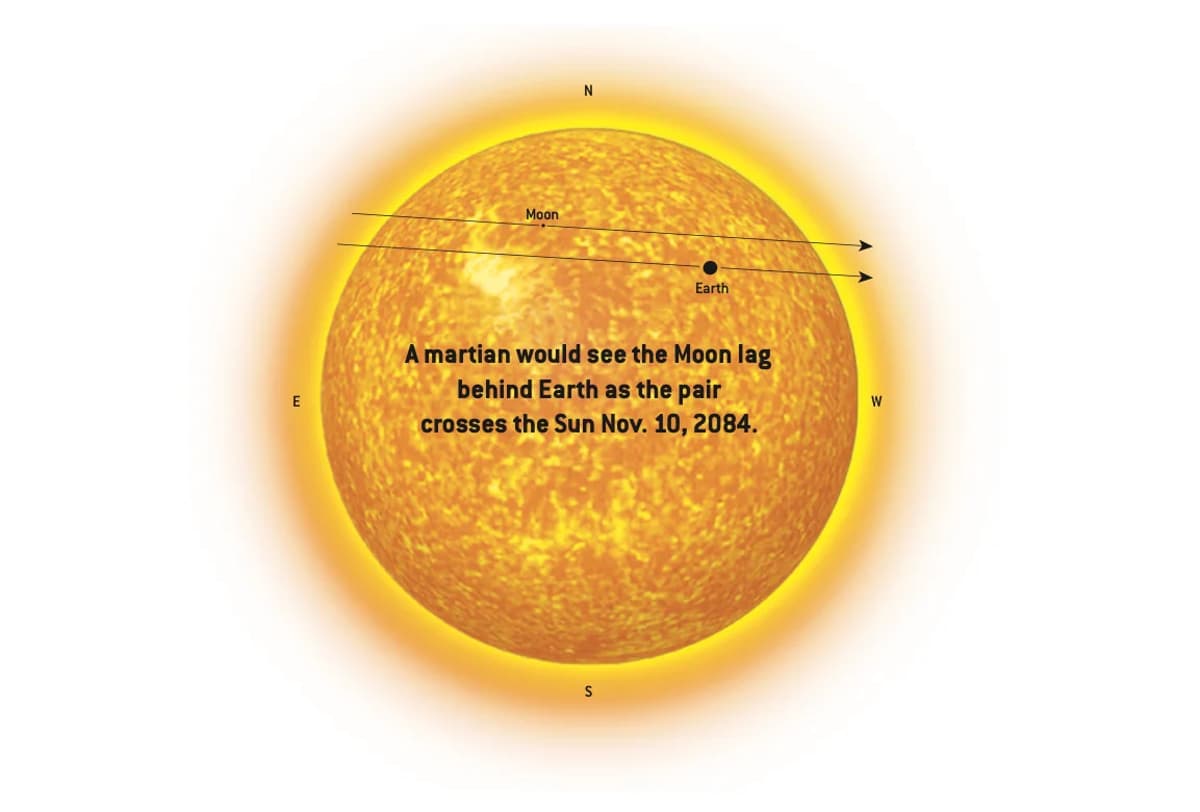
- •Next transit occurs November 10, 2084
- •Transits visible only in May or November
- •Moon often transits alongside Earth
Pulse Analysis
Planetary transits are governed by the intersecting nodes of orbital planes. For Earth to pass directly in front of the Sun as seen from Mars, the two planets must align when Mars is near either its ascending or descending node, where its tilted orbit crosses the ecliptic. This geometric constraint limits Earth‑Sun alignments to May and November, creating a predictable yet infrequent pattern that repeats every 284 years. The precise timing—100.5, 79, 25.5, and 79‑year gaps—stems from the interplay of Earth’s and Mars’ orbital periods and the slow precession of Mars’ nodes.
For crewed or robotic missions to the Red Planet, an Earth transit would be a striking visual cue. The Earth‑Moon pair would appear as sub‑arcminute silhouettes—about 36 arcseconds for Earth—requiring a solar‑filtered telescope to view safely. Observing the transit could serve as a navigation aid, confirming the spacecraft’s position relative to the Sun and Earth, and offering a unique scientific experiment to study solar limb darkening from a Martian viewpoint. Moreover, simultaneous Moon transits, which often accompany Earth’s passage, would underscore the dynamic Earth‑Moon system and provide comparative data for planetary atmospheres.
Beyond scientific utility, Earth transits capture the imagination, echoing Arthur C. Clarke’s 1971 story where a stranded astronaut witnesses the event. The next transit in 2084 will likely be observed by long‑duration rovers or future Martian habitats, reinforcing public interest in interplanetary exploration. Compared to Venus transits observed from Earth, Earth’s silhouette is smaller, yet the emotional impact of seeing one’s home world traverse the Sun from another planet is profound, symbolizing humanity’s expanding presence across the solar system.
How often does Earth transit the Sun for an observer on Mars?
0
Comments
Want to join the conversation?
Loading comments...