Why It Matters
Neutrino detection validates fundamental physics beyond the Standard Model and opens a new astronomical window, driving multi‑billion‑dollar investments in underground and under‑ice infrastructure.
Key Takeaways
- •Cowan & Reines detected neutrinos in 1956 using 10‑ton reactor detector
- •Davis’s 1960s Homestake experiment observed one‑third predicted solar neutrinos
- •Super‑Kamiokande and SNO solved solar neutrino problem via oscillation
- •IceCube mapped Milky Way in neutrinos, linking high‑energy particles to black holes
Pulse Analysis
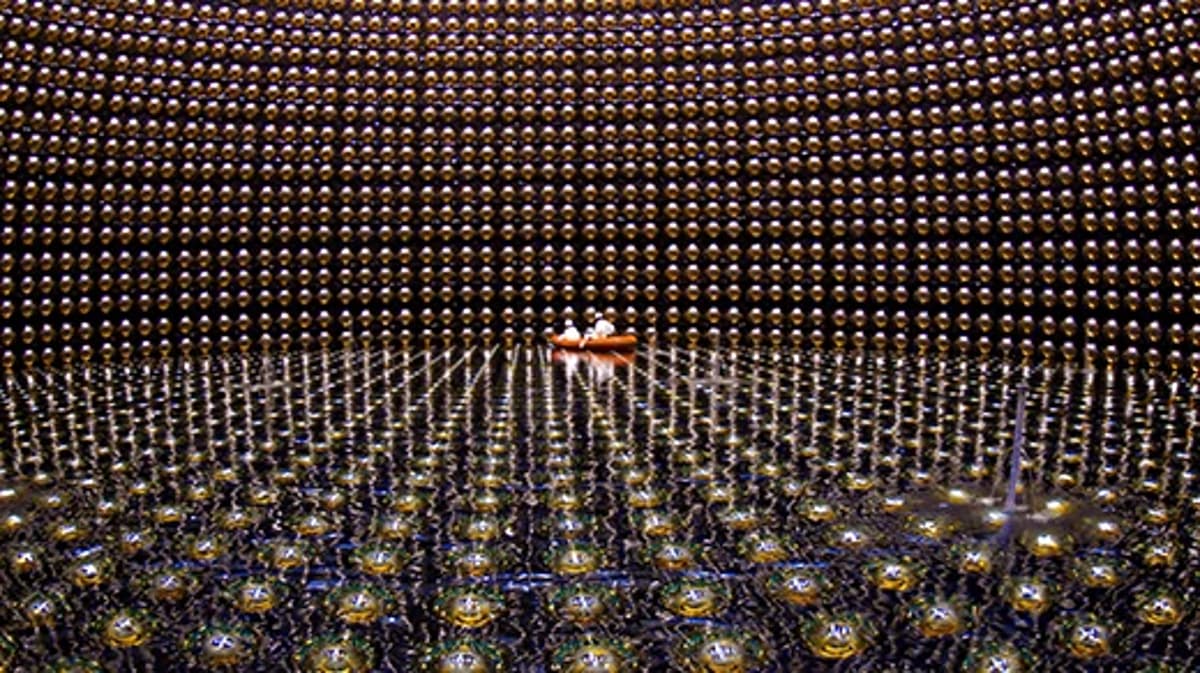
The story of neutrino research illustrates how scientific breakthroughs often require engineering feats that dwarf conventional labs. Early detectors, such as the 10‑ton reactor‑adjacent setup used by Cowan and Reines, proved that even a particle with near‑zero interaction cross‑section could be captured if enough target material and shielding were employed. This principle guided the construction of the Homestake chlorine tank and later the massive water Cherenkov detectors at Kamiokande and Super‑Kamiokande, where millions of liters of ultrapure water became the medium for rare neutrino‑induced flashes of light.
Modern experiments have taken the “think big, go deep” mantra to new extremes. IceCube leverages a cubic kilometer of Antarctic ice, embedding thousands of optical modules to trace high‑energy neutrinos from distant galaxies, while KM3NET does the same beneath the Mediterranean Sea. China’s JUNO, operational since 2025, uses a 20‑kiloton liquid scintillator to achieve sub‑percent precision on oscillation parameters, narrowing the gap in our understanding of neutrino mass hierarchy. These facilities not only confirm that neutrinos change flavor—a discovery that forced revisions to the Standard Model—but also provide a unique astrophysical messenger that can escape dense environments opaque to photons.
Looking ahead, Hyper‑K in Japan and the U.S.‑based DUNE aim to scale up detector volumes by an order of magnitude, enabling detailed studies of CP violation in the lepton sector and potentially shedding light on why the universe is matter‑dominated. The massive capital outlays—billions of dollars in construction, cryogenics, and deep‑underground excavation—reflect the high stakes: mastering neutrinos could unlock new physics, improve nuclear monitoring, and enhance multi‑messenger astronomy. As the field matures, the blend of particle physics, engineering, and international collaboration will remain the engine driving discovery.
How Physicists Track and Trap the Elusive Neutrino
Comments
Want to join the conversation?
Loading comments...