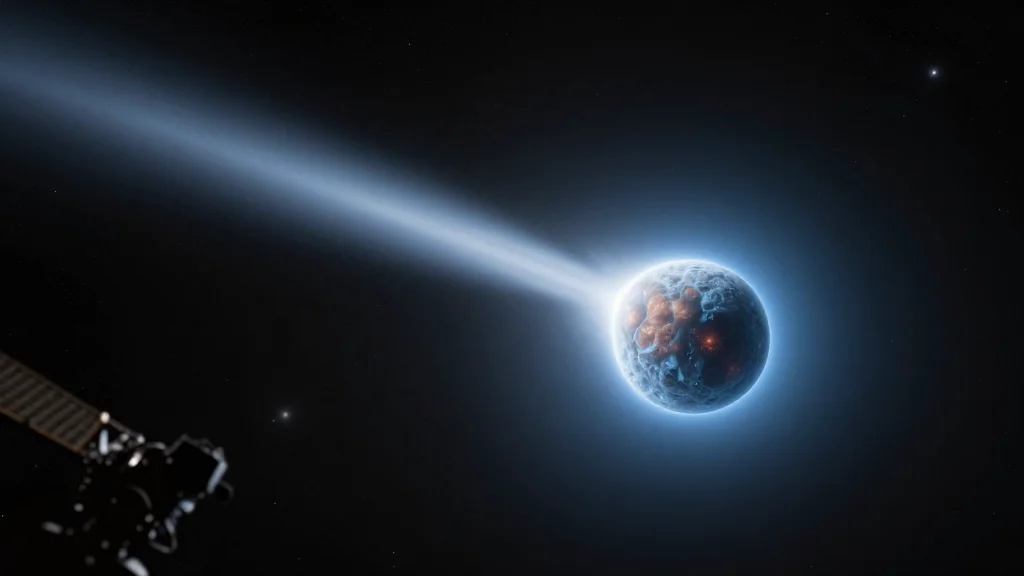
Hubble and ALMA Reveal 3I/ATLAS as a Deuterium‑Rich Time Capsule From Another Star System

Why It Matters
The detection of extreme deuterium enrichment in 3I/ATLAS provides the first direct chemical fingerprint of a planetary system other than the Sun's. By linking isotopic ratios to formation environments, scientists can test theories of how water and organics are distributed across the galaxy, informing models of planet habitability and the origins of Earth's water. Moreover, the success of coordinated Hubble‑ALMA observations sets a precedent for rapid, high‑impact science on transient interstellar objects, expanding our ability to study the building blocks of distant worlds. Beyond planetary science, the findings have broader astrophysical relevance. Deuterium is a relic of Big Bang nucleosynthesis, and its varying abundance in different star‑forming regions can trace the chemical evolution of the Milky Way. Understanding these variations helps refine galactic chemical evolution models and may reveal how early‑generation stars contributed to the enrichment of subsequent planetary systems.
Key Takeaways
- •Hubble and ALMA observed interstellar comet 3I/ATLAS in November 2025.
- •Deuterium in the comet’s water is >40× higher than in Earth’s oceans.
- •The comet is the third known interstellar object, offering a rare compositional snapshot.
- •Findings suggest formation in a cold, dense region of another planetary system.
- •Study paves the way for rapid, multi‑facility observations of future interstellar visitors.
Pulse Analysis
The 3I/ATLAS discovery arrives at a pivotal moment for planetary science, where the scarcity of interstellar samples has long limited our understanding of exoplanetary chemistry. Historically, researchers relied on indirect inferences from exoplanet atmospheres or meteorite analyses. This direct measurement of deuterium—a tracer of temperature and chemical processing—breaks new ground, allowing scientists to anchor theoretical models in empirical data.
From a competitive standpoint, the collaboration between NASA’s Hubble, ESA’s Hubble operations, and the ALMA consortium showcases a model of international, cross‑facility synergy that could become the standard for transient astronomy. As the Vera C. Rubin Observatory ramps up, the bottleneck will shift from detection to rapid characterization. Facilities that can swiftly allocate observing time, like ALMA’s flexible scheduling and JWST’s target‑of‑opportunity mode, will dominate the scientific returns.
Looking forward, the community faces a strategic choice: invest in dedicated interstellar object missions, such as a fly‑by probe, or continue leveraging existing observatories for opportunistic studies. The 3I/ATLAS results argue for the former, suggesting that a spacecraft equipped to sample volatile material in situ could unlock a wealth of isotopic and organic data unattainable from Earth. Until such missions materialize, the emphasis must remain on building robust, automated pipelines that can trigger observations within hours of discovery, ensuring that each interstellar visitor becomes a laboratory for comparative planetology.
Hubble and ALMA Reveal 3I/ATLAS as a Deuterium‑Rich Time Capsule from Another Star System
Comments
Want to join the conversation?
Loading comments...