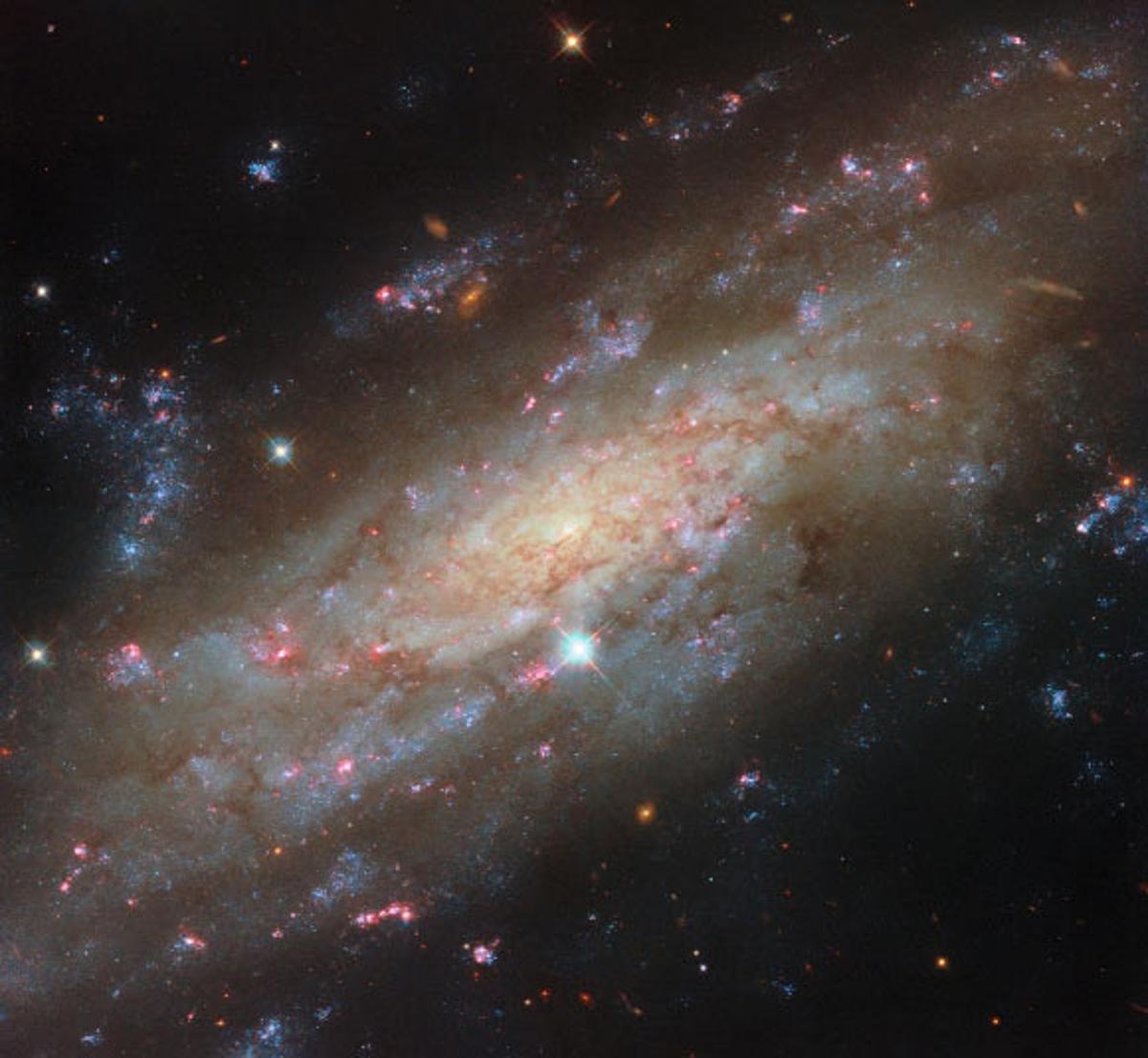
Hubble Captures Spiral Galaxy Packed with Brilliant Star Clusters: NGC 3137
Why It Matters
The high‑resolution data improve age‑dating of star clusters, refining galaxy‑evolution models, while the group’s similarity to the Local Group provides a nearby laboratory for testing Milky Way‑centric theories.
Key Takeaways
- •NGC 3137 lies 53 Mly away, spanning ~140,000 light‑years.
- •Central black hole estimated at 60 million solar masses.
- •PHANGS‑HST reveals dense blue clusters and red nebulae.
- •Galaxy belongs to NGC 3175 group, a Local‑Group analog.
- •Star‑cluster ages will calibrate spiral‑galaxy evolution models.
Pulse Analysis
The Hubble Space Telescope continues to push the frontier of extragalactic astronomy, and the PHANGS‑HST program exemplifies its power. By targeting 55 nearby galaxies, PHANGS delivers sub‑arcsecond resolution that isolates individual star clusters and their surrounding nebulae. This level of detail, unavailable from ground‑based observatories, allows researchers to map the distribution of young, massive stars and trace the interstellar medium’s structure, feeding directly into models of star‑formation efficiency across diverse galactic environments.
NGC 3137 stands out within the PHANGS sample thanks to its striking spiral arms, dusty core, and a supermassive black hole estimated at 60 million solar masses. The new Hubble image showcases a tapestry of bright blue clusters—sites of hot, newly formed stars—intermixed with glowing red gas clouds that mark active stellar nurseries. By measuring the colors and luminosities of these clusters, astronomers can assign precise ages, constructing a timeline of star formation that spans from recent bursts to ancient populations. This granular view sharpens our understanding of how spiral galaxies recycle gas into successive generations of stars.
Beyond its internal features, NGC 3137’s membership in the NGC 3175 galaxy group offers a broader comparative angle. The group mirrors the Milky Way’s Local Group, containing two dominant spirals and a suite of dwarf companions. Studying such an analog helps test theories of group dynamics, satellite accretion, and dark‑matter halo interactions that are otherwise inferred from our own neighborhood. As PHANGS continues to release data, NGC 3137 will serve as a benchmark for linking small‑scale star‑cluster physics with large‑scale galactic evolution, informing both observational strategies and cosmological simulations.
Hubble Captures Spiral Galaxy Packed with Brilliant Star Clusters: NGC 3137
Comments
Want to join the conversation?
Loading comments...