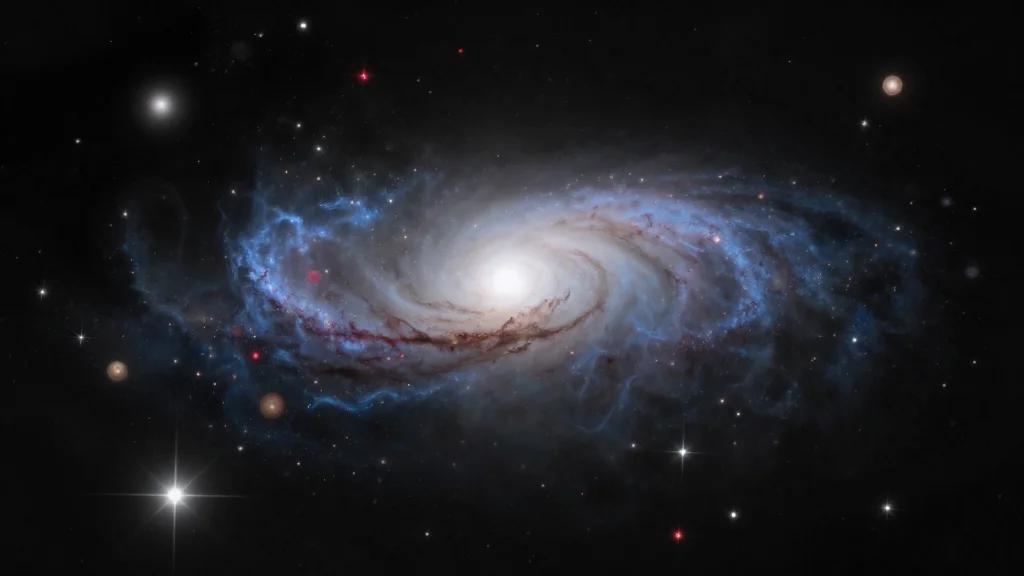
Hubble Spies Faint Irregular Galaxy ESO 490-017
Companies Mentioned

NASA

ESA
Why It Matters
Accurate distance measurements of faint galaxies refine models of large‑scale cosmic flow, improving our understanding of the universe’s structure and evolution.
Key Takeaways
- •ESO 490‑017 spans ~12,000 light‑years, 23 million ly distant.
- •Hubble measured red‑giant standard candles to determine galaxy distance.
- •Image reveals faint galaxy amid foreground stars with diffraction spikes.
- •Study contributes to mapping cosmic flow of large‑scale structures.
- •Archive provides stellar population data for nearby dwarf irregular galaxies.
Pulse Analysis
The Hubble Space Telescope continues to excel at unveiling low‑surface‑brightness objects that challenge ground‑based observatories. By resolving individual red‑giant stars in ESO 490‑017, Hubble provides a direct distance estimate that bypasses the uncertainties of redshift‑based methods. This capability is especially valuable for dwarf irregular galaxies, whose diffuse nature often leaves them under‑represented in large surveys, yet they hold clues to star formation in low‑density environments.
Measuring distances with red‑giant standard candles anchors the cosmic distance ladder, allowing astronomers to chart the so‑called "cosmic flow"—the collective motion of galaxies driven by uneven mass distribution. The ESO 490‑017 observation feeds into a broader dataset that maps how galaxy clusters drift relative to the cosmic microwave background. Such precision improves simulations of dark matter’s gravitational influence and refines estimates of the Hubble constant, a key parameter in cosmology.
Beyond pure science, the legacy archive generated by this program offers a rich repository for future research and commercial applications, such as algorithm training for AI‑driven image analysis. As private firms increasingly partner with space agencies on data‑intensive projects, the high‑resolution stellar catalogs from Hubble become valuable assets. Continued investment in space‑based observatories ensures that both the academic community and emerging space‑tech enterprises can leverage cutting‑edge observations to drive innovation.
Hubble spies faint irregular galaxy ESO 490-017
Comments
Want to join the conversation?
Loading comments...