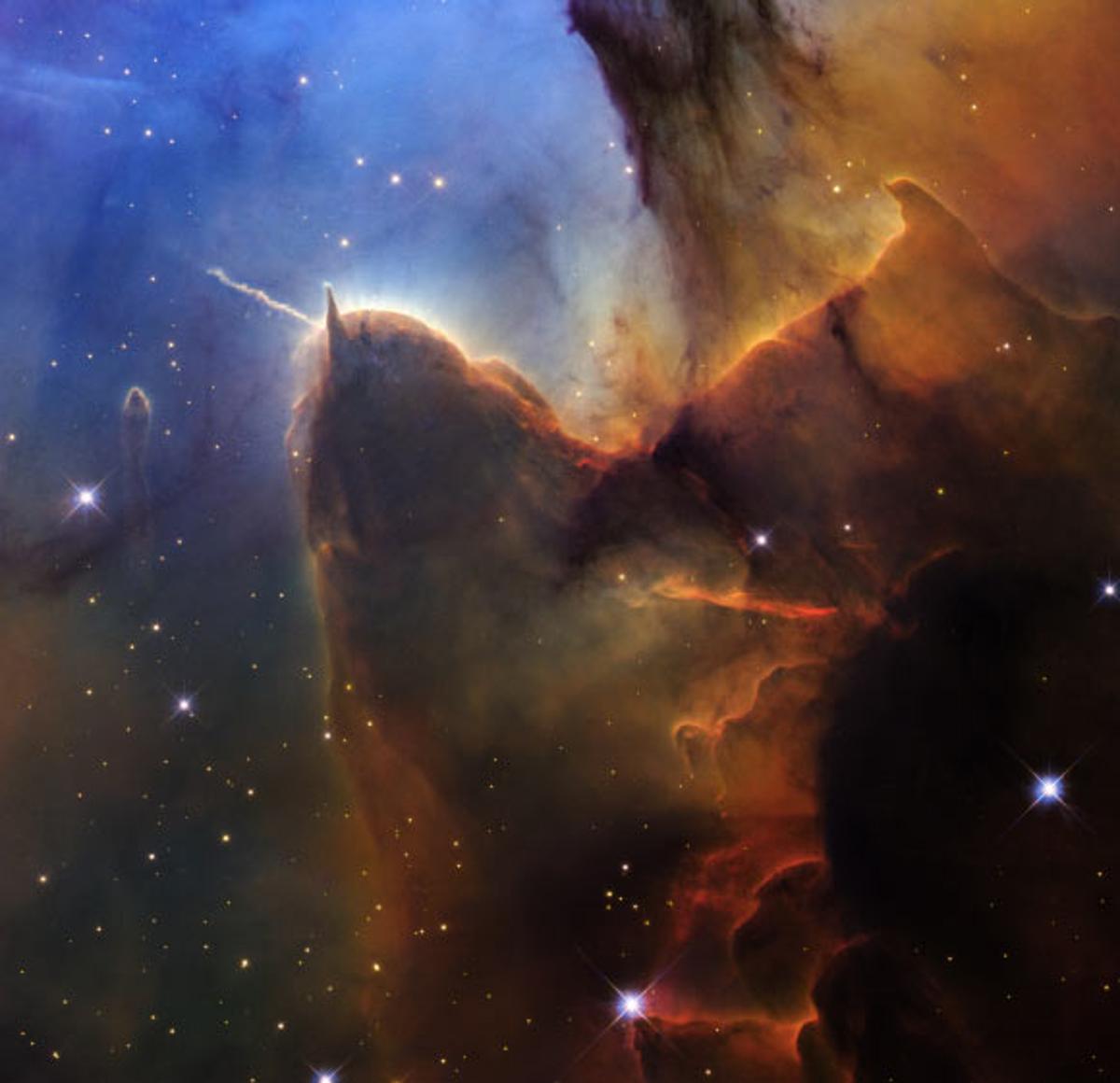
Why It Matters
The time‑lapse view demonstrates that massive star‑forming regions evolve perceptibly within decades, refining models of stellar feedback and nebular dynamics. It underscores the value of long‑baseline space imaging for decoding the life cycle of galaxies.
Key Takeaways
- •Hubble revisited Trifid Nebula after 29 years, revealing visible changes.
- •UV winds from massive stars compress gas, triggering new star formation.
- •Jet Herbig‑Haro 399 measured, showing protostar energy output.
- •New camera’s wider field captures finer details of dust pillars.
- •Observations illustrate nebula’s evolution on human timescales.
Pulse Analysis
The Hubble Space Telescope’s 36th‑birthday image of the Trifid Nebula showcases the power of long‑term astronomical monitoring. By revisiting the same field after nearly three decades, Hubble leveraged its upgraded Wide Field Camera 3 to deliver higher sensitivity and a broader view, exposing subtle shifts in the nebula’s structure that were invisible in the 1997 snapshot. This side‑by‑side comparison highlights how space‑based observatories can produce true time‑lapse science, turning a static sky into a dynamic laboratory.
Beyond the visual spectacle, the new data reveal critical physical processes shaping star‑forming regions. Ultraviolet radiation and stellar winds from massive, older stars are carving out bubbles that compress surrounding gas, seeding the next generation of stars. The detection and measurement of the Herbig‑Haro 399 jet, along with its counter‑jet, allow astronomers to quantify the energy output of a protostar and trace how such outflows inject momentum into their natal clouds. These observations refine theoretical models of feedback, where young stars both nurture and disrupt their birth environments, influencing the efficiency and timeline of star formation.
The Trifid’s evolving portrait underscores a broader lesson for the astronomical community: sustained, high‑resolution imaging is indispensable for understanding cosmic evolution. As Hubble approaches the end of its operational life, upcoming facilities like the James Webb Space Telescope and the Nancy Grace Roman Space Telescope will inherit this legacy, offering infrared eyes to peer through dust and extend the temporal baseline even further. For both scientists and the public, witnessing a nebula change within a human lifetime reinforces the dynamic nature of the universe and the importance of continued investment in long‑duration space missions.
Hubble’s 36th Birthday Image Shows Trifid Nebula
Comments
Want to join the conversation?
Loading comments...