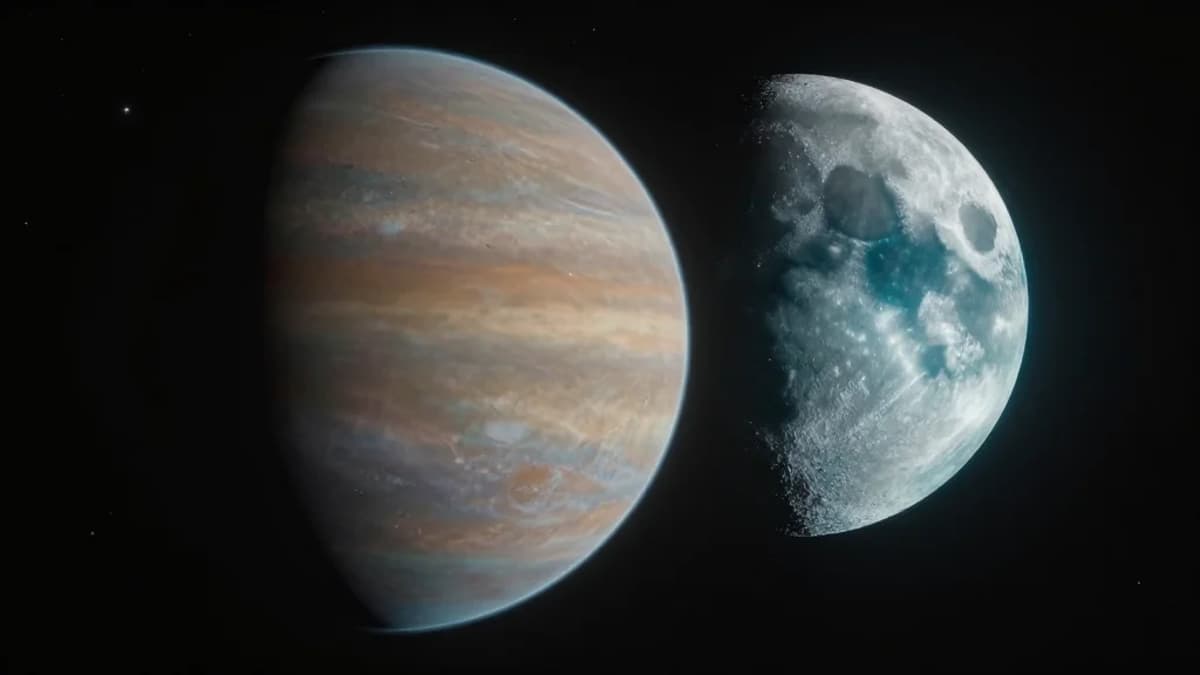
Hydrogen Atmosphere Could Keep Exomoons Habitable for Billions of Years
•March 11, 2026
0
Why It Matters
It widens the search for life beyond traditional star‑bound worlds and informs models of planetary habitability across the galaxy.
Key Takeaways
- •Free‑floating planets may equal stars in number
- •Hydrogen atmospheres trap heat via collision‑induced absorption
- •Tidal heating can sustain oceans for billions of years
- •Early Earth may have experienced similar hydrogen‑rich conditions
- •Expands viable habitats to interstellar space
Pulse Analysis
The conventional view of habitability centers on a planet’s distance from a luminous star, defining a narrow "habitable zone" where liquid water can exist. Recent work from the Excellence Cluster ORIGINS and the Max Planck Institute challenges that paradigm by showing that moons tethered to rogue, or free‑floating, gas giants can remain temperate for billions of years. By decoupling habitability from stellar irradiation, the study opens a vast, previously overlooked region of the Milky Way for astrobiological consideration.
At the heart of this stability is a dense hydrogen envelope. Under extreme pressures, hydrogen molecules experience collision‑induced absorption, a process that converts otherwise transparent gas into an effective infrared blanket. Unlike carbon dioxide, which would condense and lose its greenhouse effect in the frigid interstellar medium, hydrogen remains gaseous and continues to trap thermal energy. Coupled with tidal heating—generated as the moon’s eccentric orbit around its planet flexes its interior—the combined heat budget can keep surface oceans liquid for up to 4.3 billion years, rivaling Earth’s own habitability timeline.
The implications for the search for extraterrestrial life are profound. If rogue planets are as common as stars, their moons could vastly outnumber traditional exoplanets as potential abodes for life. Future infrared surveys and microlensing missions may need to incorporate signatures of hydrogen‑rich atmospheres and tidal heating into their detection algorithms. Moreover, the study offers a fresh lens on Earth’s early environment, suggesting that transient hydrogen spikes from impacts might have played a role in pre‑biotic chemistry. By expanding the definition of a "habitable world," this research reshapes priorities for both observational campaigns and theoretical models.
Hydrogen atmosphere could keep exomoons habitable for billions of years
0
Comments
Want to join the conversation?
Loading comments...