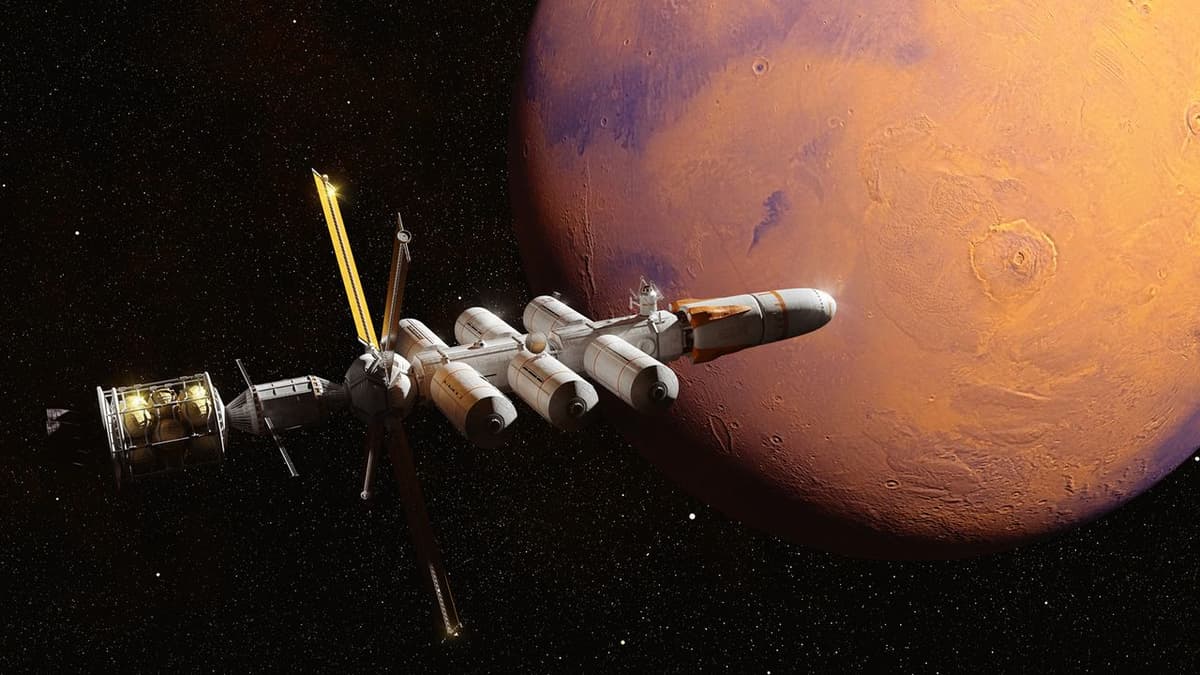
'I Was Not Looking for This': Scientist Accidentally Finds Shortcut to Mars that Could Slash Travel Time in Half
Why It Matters
If realized, such trajectories could halve mission durations, reducing crew exposure and mission costs, and accelerate human presence on Mars.
Key Takeaways
- •34‑day Earth‑Mars leg requires ~32.5 km/s departure speed.
- •2031 opposition enables 153‑day round‑trip using near‑term tech.
- •Lower‑energy option offers 226‑day mission with 16.5 km/s launch.
- •Method leverages early asteroid geometry to find fast interplanetary routes.
Pulse Analysis
Current human‑rated Mars concepts rely on Hohmann‑type transfers that take seven to ten months each way and require a 26‑month launch window, stretching a round‑trip to nearly three years. The long transit time drives higher life‑support costs, increased radiation exposure, and complex mission logistics. As agencies and commercial players race to land crews on the Red Planet, any reduction in travel duration could reshape architecture, allowing more frequent flights and smaller, more flexible mission profiles.
The Acta Astronautica paper by Marcelo de Oliveira Souza repurposes early orbital estimates of near‑Earth asteroid 2001 CA21 to expose a geometric shortcut. By constraining Lambert trajectories within five degrees of the asteroid’s initial inclination, the study identifies a 34‑day outbound leg at roughly 32.5 km s⁻¹—speeds comparable to the New Horizons flyby. While present launch vehicles cannot achieve such velocity, the 2031 Earth‑Mars opposition offers a more realistic 27 km s⁻¹ profile that could complete a round‑trip in 153 days, with a lower‑energy 226‑day alternative.
If propulsion advances such as SpaceX’s Starship or Blue Origin’s New Glenn can approach these velocities, mission planners could halve the time crews spend in deep‑space radiation, cut consumable mass, and lower overall program budgets. The asteroid‑inspired methodology also provides a systematic way to scan future oppositions for similar fast lanes, potentially accelerating the cadence of crewed Mars flights. Nonetheless, engineering challenges—thermal protection, entry‑descent‑landing systems, and high‑Δv propulsion—must be resolved before the concept moves from theory to flight.
'I was not looking for this': Scientist accidentally finds shortcut to Mars that could slash travel time in half
Comments
Want to join the conversation?
Loading comments...