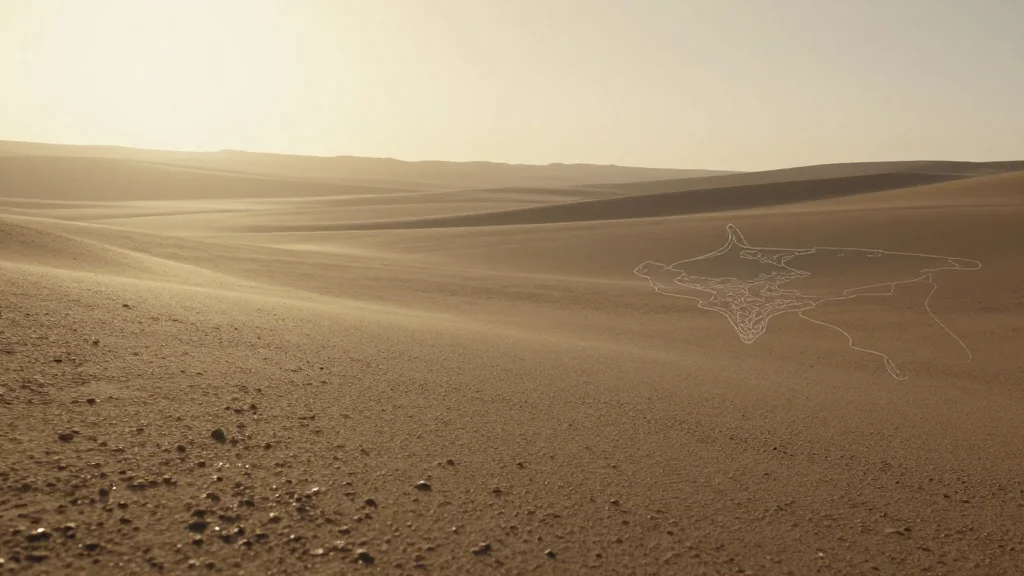
Identifying the Topographic Signature of Early Martian Oceans
Why It Matters
Confirming a Martian coastal shelf reshapes our understanding of the planet’s hydrologic history and provides a concrete target for upcoming exploration missions seeking oceanic deposits.
Key Takeaways
- •Identified a low‑slope, low‑curvature zone on Mars between –1.8 km and –3.8 km
- •Zone covers ~10.2 million km², ~7 % of Martian surface
- •Shelf detection aligns with known Martian deltas and proposed shorelines
- •Earth analog shows continental shelves have distinct slope ≈0.08° and curvature minima
- •Findings support a long‑lived ancient ocean and guide future rover targets
Pulse Analysis
The debate over whether Mars once hosted a global ocean has long hinged on ambiguous shoreline traces in the planet’s northern lowlands. Traditional interpretations focus on linear elevation breaks, but such features can be distorted by true polar wander, Tharsis loading, or post‑depositional erosion. By shifting the focus to the broader morphometric signature of a continental shelf—characterized on Earth by a pronounced dip in slope and curvature near sea level—researchers have introduced a more resilient proxy for ancient marine environments.
Using high‑resolution MOLA topography, the team replicated Earth’s shelf‑defining metrics, pinpointing two coupled minima in slope and curvature on Mars. The primary minimum, between –1.8 km and –3.8 km, aligns with the distribution of Martian deltas, valley networks, and the historically cited Arabia and Deuteronilus shoreline zones. Automated classification via the Geomorphons algorithm identified a contiguous low‑gradient area covering 10.2 million km², suggesting a planetary‑scale shelf that survived billions of years of wind erosion, impact gardening, and volcanic resurfacing.
If Mars indeed possessed such a shelf, the implications extend beyond paleoclimate reconstruction. A preserved marine margin would concentrate sedimentary records of carbonate deposition, potential organic preservation, and mineralogical signatures like clays—key biosignatures for astrobiology. Future missions, including the European Rosalind Franklin rover slated for Oxia Planum, can prioritize these shelf regions to sample stratigraphic sequences analogous to Earth’s coastal deposits. Moreover, the methodological framework offers a template for detecting ancient oceans on exoplanets, where direct shoreline imaging is impossible but global topographic data may become accessible through next‑generation radar and interferometry.
Identifying the topographic signature of early Martian oceans
Comments
Want to join the conversation?
Loading comments...