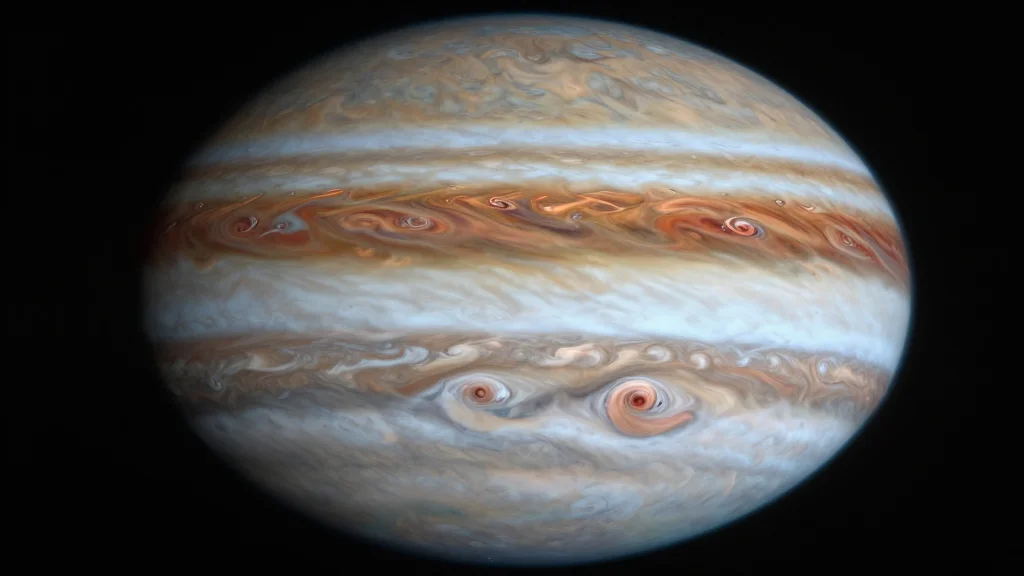
Image: Colorful, Chaotic Jupiter
Why It Matters
The enhanced view offers researchers unprecedented detail on Jupiter’s jet‑breakdown zones, improving models of gas‑giant atmospheric dynamics, while showcasing how citizen science can accelerate scientific discovery.
Key Takeaways
- •Juno's 61st flyby captured northern hemisphere on May 12, 2024.
- •Citizen scientist Gary Eason processed JunoCam data into color‑enhanced image.
- •Image reveals chaotic clouds and cyclonic storms in folded filamentary region.
- •Zonal jets break down there, creating rapidly evolving turbulence.
- •Enhanced visuals aid researchers studying Jupiter’s atmospheric dynamics.
Pulse Analysis
The Juno mission, now in its twelfth year, continues to push the boundaries of planetary observation. Its JunoCam instrument, originally designed for public outreach, has become a workhorse for high‑resolution imaging, delivering raw data that can be re‑processed for scientific insight. By involving citizen scientists like Gary Eason, NASA taps a global talent pool, turning raw telemetry into striking visualizations that both engage the public and provide researchers with clearer, color‑balanced views of complex atmospheric features.
The newly released image zeroes in on Jupiter’s folded filamentary region—a narrow band where the planet’s powerful zonal jets lose cohesion. In this zone, the normally orderly banded appearance gives way to turbulent eddies, chaotic cloud decks, and rapidly shifting cyclonic storms. Color enhancement amplifies subtle variations in methane absorption and aerosol composition, allowing scientists to trace the vertical structure of these storms and assess how energy cascades from large‑scale jets to smaller vortices. Such detail is crucial for refining fluid‑dynamics models that explain not only Jupiter’s weather but also the behavior of other gas giants, both in our solar system and beyond.
Beyond pure science, the collaboration highlights a broader trend toward open‑source planetary research. As more raw datasets become publicly accessible, the line between professional astronomers and enthusiastic amateurs blurs, accelerating discovery cycles. The insights gained from Juno’s flybys inform the design of upcoming missions—like Europa Clipper and the proposed Jupiter Icy Moons Explorer—by illustrating which atmospheric phenomena merit closer scrutiny. Ultimately, the vivid, citizen‑crafted image serves as a reminder that modern space exploration thrives on both cutting‑edge technology and community participation, driving a deeper understanding of the dynamic worlds that share our cosmic neighborhood.
Image: Colorful, chaotic Jupiter
Comments
Want to join the conversation?
Loading comments...