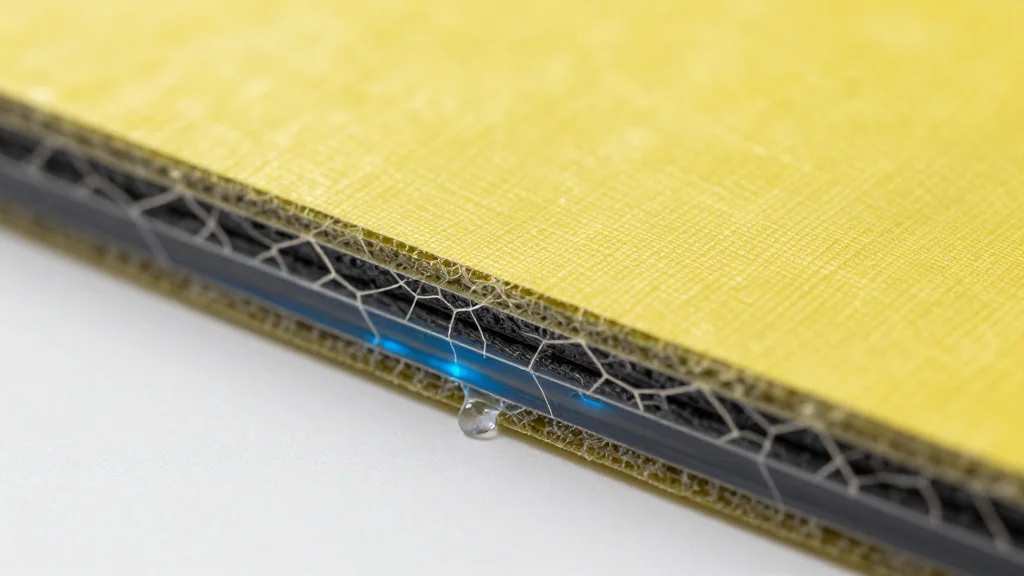
IMDEA Materials Develops Multifunctional Kevlar Using Laser Photothermal Conversion
Why It Matters
Embedding sensing, electromagnetic protection and thermal management directly into structural composites reduces weight, part count and system complexity, accelerating adoption of smarter, lighter components in high‑performance industries.
Key Takeaways
- •Laser‑induced graphene patterned directly on Kevlar fabrics
- •Composite retains baseline strength while adding multifunctionality
- •Gauge factor ~1.0 enables real‑time strain monitoring
- •Joule heating reaches >50 °C, de‑icing ice at –40 °C in 5 min
- •Vacuum infusion process compatible with industrial‑scale production
Pulse Analysis
The breakthrough hinges on laser photothermal conversion, which transforms the surface of Kevlar fibers into a conductive graphene network without compromising the material’s inherent tensile properties. By depositing laser‑induced graphene (LIG) directly onto the fabric, the researchers eliminate the need for separate sensor or shielding layers, streamlining the laminate architecture. This approach dovetails with existing vacuum‑infusion techniques, offering a clear pathway from laboratory to factory floor while preserving the high‑strength, low‑weight advantages that make Kevlar a staple in aerospace and defense.
Beyond structural integrity, the new composite delivers three high‑value functions in a single panel. The embedded LIG acts as a piezoresistive sensor, delivering a gauge factor close to 1.0 for accurate deformation tracking—critical for health‑monitoring of wind‑turbine blades or electric‑vehicle battery enclosures. Simultaneously, the conductive network provides electromagnetic interference (EMI) shielding, protecting sensitive electronics from external noise. Finally, the material’s Joule‑heating capability enables rapid de‑icing, achieving temperatures above 50 °C at modest voltages and melting ice at –40 °C within minutes, a feature attractive to aerospace and offshore wind applications.
Despite the promise, scaling the technology presents hurdles. Precise control of resin flow during infusion, especially thickness uniformity, remains a bottleneck, as does the long‑term electromechanical stability of surface contacts under cyclic loading. Repeated heating cycles could also degrade the epoxy matrix locally. Ongoing research aims to refine LIG morphology, embed robust electrodes, and develop predictive models to mitigate these risks, positioning the multifunctional Kevlar composite as a viable next‑generation material for smart, lightweight structures.
IMDEA Materials develops multifunctional Kevlar using laser photothermal conversion
Comments
Want to join the conversation?
Loading comments...