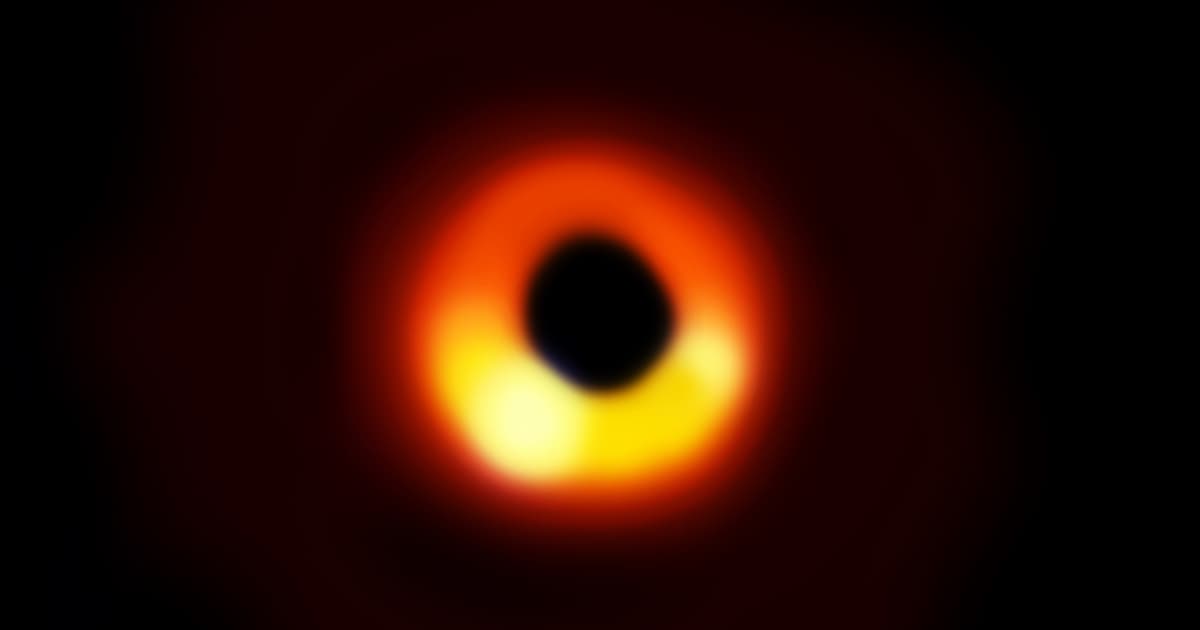
In 2022 the Event Horizon Telescope Revealed the First Image of the Monster at Our Galaxy’s Center, Sagittarius A* — a Black Hole 4 Million Times the Sun’s Mass, Sitting Quietly 27,000 Light-Years Away the Whole Time
Why It Matters
The direct visual confirmation of a black hole at our galaxy’s core validates general relativity under unprecedented conditions and creates a nearby laboratory for studying accretion physics, influencing both astrophysics research and future gravitational‑wave investigations.
Key Takeaways
- •EHT captured Sagittarius A* image after five years of data.
- •Ring diameter 51.8 µas aligns with general relativity predictions.
- •Gas orbits Sgr A* in ~30 minutes, causing rapid variability.
- •Over 300 scientists at 80 institutes processed the observations.
- •Result enables future movies of black‑hole environment.
Pulse Analysis
The Event Horizon Telescope’s success with Sagittarius A* builds on its historic 2019 image of M87*, but the technical hurdles were far steeper. Unlike the massive M87* whose emission changes over weeks, Sgr A*’s smaller mass forces gas to orbit in minutes, turning the source into a flickering target. To overcome this, the EHT team stitched together data from eight globally distributed radio observatories, creating an Earth‑sized virtual dish. Over five years, more than 300 researchers refined algorithms, simulated thousands of black‑hole models, and averaged countless noisy frames to extract a coherent ring structure, demonstrating the power of international collaboration and high‑performance computing in modern astronomy.
Scientifically, the 51.8 microarcsecond ring size is a striking confirmation of general relativity’s predictions for a 4‑million‑solar‑mass black hole at 27,000 light‑years. By matching the mass‑to‑distance ratio derived from stellar orbits, the image narrows the parameter space where alternative gravity theories could manifest. Moreover, the rapid variability observed offers a rare probe of magnetohydrodynamic turbulence and particle acceleration near the event horizon, informing models of jet formation and high‑energy emission that apply to active galactic nuclei across the universe.
Looking ahead, the static image is only the first frame of a forthcoming cinematic era. With upgraded baselines, higher‑frequency receivers, and real‑time data pipelines, the EHT aims to produce movies that track plasma motion on minute‑scale intervals. Such dynamic visualizations will sharpen tests of spacetime curvature, constrain black‑hole spin, and refine our understanding of accretion physics. The technological spin‑offs—advanced signal processing, distributed computing, and precision timing—also ripple into sectors like telecommunications and quantum sensing, underscoring how fundamental astrophysics can drive broader innovation.
In 2022 the Event Horizon Telescope revealed the first image of the monster at our galaxy’s center, Sagittarius A* — a black hole 4 million times the Sun’s mass, sitting quietly 27,000 light-years away the whole time
Comments
Want to join the conversation?
Loading comments...