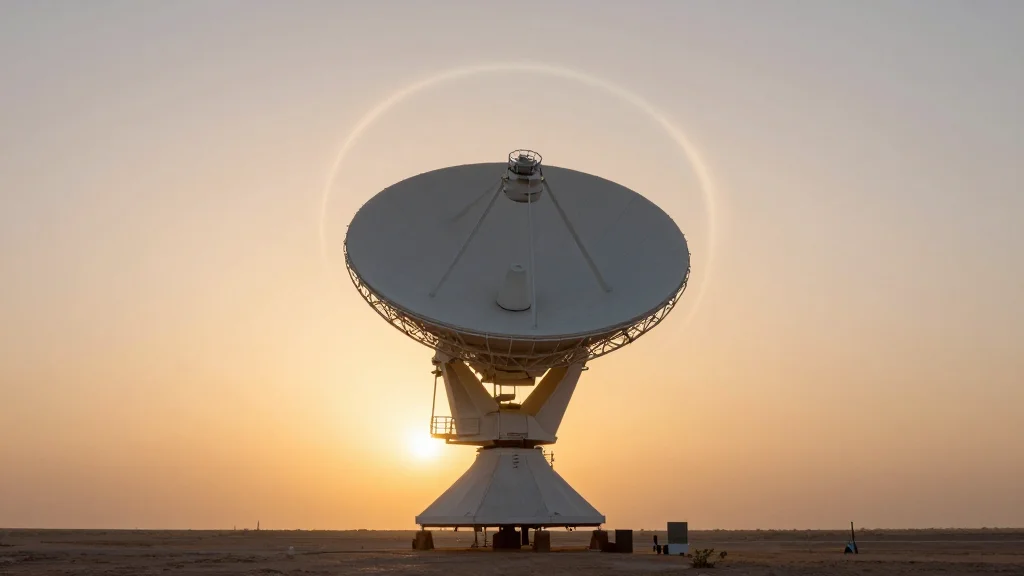
Indian Team Directly Measures Ultra‑Weak Solar Corona Magnetic Fields

Why It Matters
Directly measuring the Sun’s coronal magnetic fields resolves a critical uncertainty in heliophysics, enabling more reliable forecasts of solar storms that threaten global communications and energy infrastructure. By proving that a modestly funded, domestically built telescope can achieve this feat, the work also signals a shift toward diversified, cost‑effective research platforms, potentially accelerating discoveries in other astrophysical domains. Beyond operational benefits, the finding deepens our fundamental understanding of stellar magnetic activity, offering a template for studying other stars whose magnetic environments influence exoplanet habitability. As space‑based assets become ever more integral to daily life, improving space‑weather prediction becomes a matter of both scientific curiosity and societal resilience.
Key Takeaways
- •IIA researchers directly measured coronal magnetic fields weaker than 0.001 Tesla.
- •The measurement used a radio telescope built entirely in India at Gauribidanur Observatory.
- •Fields detected are comparable to those of simple bar magnets, far weaker than typical industrial magnets.
- •The data will improve models of solar eruptions, aiding forecasts that protect satellites and power grids.
- •The study highlights India's growing expertise in low‑cost, high‑precision radio astronomy.
Pulse Analysis
The Gauribidanur result arrives at a moment when the global solar‑physics community is grappling with the limits of existing observation platforms. Space missions such as Parker Solar Probe and Solar Orbiter provide unprecedented close‑up data, yet they cannot directly resolve the magnetic topology of the extended corona. By filling that gap from the ground, the Indian team demonstrates a complementary approach that could democratize access to critical solar data.
Historically, coronal magnetic field estimates have relied on indirect techniques—Zeeman splitting in infrared lines, Faraday rotation of background radio sources, or extrapolations from photospheric magnetograms. Each method carries sizable uncertainties, often leading to divergent predictions of CME initiation. The Gauribidanur measurement, anchored in a direct radio‑polarization signature, offers a tangible benchmark that can calibrate these models. If subsequent observations confirm the initial findings across solar cycles, we may see a paradigm shift where ground‑based radio arrays become standard components of space‑weather monitoring networks.
From a strategic perspective, the achievement underscores the value of indigenous instrument development. India's ability to design, fabricate, and operate a telescope that rivals more expensive foreign installations could inspire other emerging economies to invest in similar capabilities. This could accelerate a more distributed global observatory network, reducing reliance on a handful of flagship facilities and fostering collaborative data sharing. In the longer term, the technique may be adapted to study magnetic environments around other stars, opening a new window into stellar activity cycles and their impact on exoplanetary atmospheres.
Indian Team Directly Measures Ultra‑Weak Solar Corona Magnetic Fields
Comments
Want to join the conversation?
Loading comments...