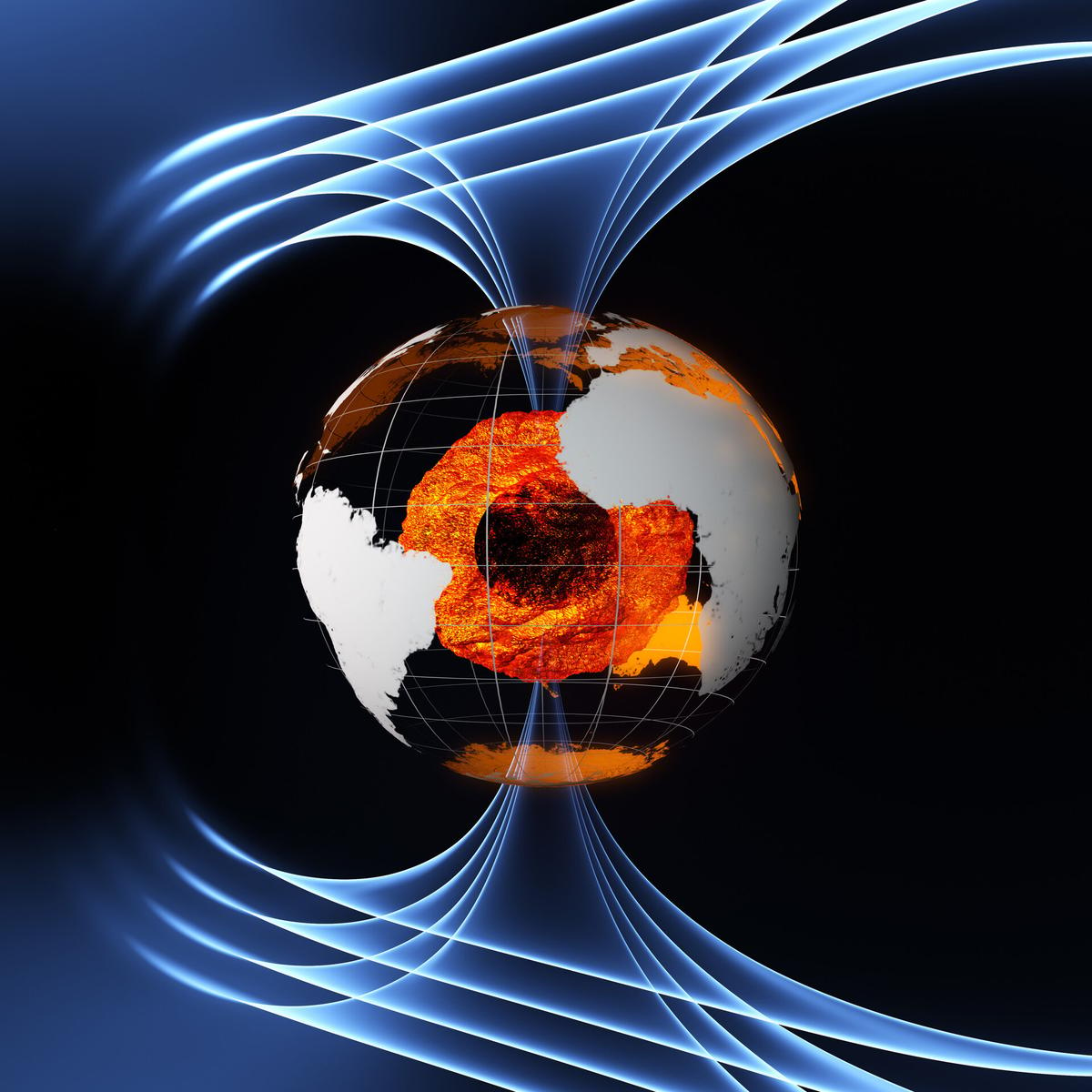
Insights Into Earth’s Molten Outer Core From Space
Why It Matters
Understanding sudden changes in outer‑core flow refines models of Earth’s magnetic field, which underpins navigation, satellite operations, and space‑weather forecasting. The findings also challenge long‑standing assumptions of a stable westward circulation, prompting new research into deep‑Earth dynamics.
Key Takeaways
- •Swarm and CryoSat data revealed 2010 eastward flow reversal
- •Eastward flow weakened after 2020, suggesting temporary oscillation
- •Study links outer‑core changes to inner‑core behavior
- •Findings challenge assumption of stable westward core circulation
Pulse Analysis
The Earth’s magnetic shield originates from the geodynamo, a self‑sustaining flow of liquid iron in the outer core that circulates around the solid inner core. For decades, geomagnetic observations inferred a largely steady westward drift at the core‑mantle boundary, supporting models that treated the outer‑core circulation as relatively stable. Recent advances in satellite magnetometry, however, have opened a window into the deep interior, allowing scientists to resolve finer‑scale variations that ground observatories cannot detect.
ESA’s Swarm constellation, launched in 2013, together with CryoSat, CHAMP, and Ørsted, provided high‑precision magnetic field measurements spanning nearly three decades. By isolating core‑generated signals from crustal and ionospheric noise, researchers reconstructed the flow pattern beneath the Pacific and identified a sudden reversal in 2010, when the iron‑rich fluid switched to a strong eastward motion. The reversal coincided with a 2017 geomagnetic jerk and peaked around 2017‑2020 before the model indicates a gradual weakening, hinting at a possible oscillatory cycle rather than a permanent shift.
These insights have practical and scientific ramifications. A fluctuating core flow can alter the rate and geometry of magnetic field change, affecting compass reliability, satellite attitude control, and radiation‑belt modeling. Moreover, the apparent coupling between outer‑core flow and inner‑core dynamics suggests a more interconnected deep‑Earth system than previously thought, prompting revisions to geodynamo simulations. Continued satellite monitoring, especially with future missions building on Swarm’s legacy, will be crucial for anticipating magnetic field evolution and safeguarding the technological infrastructure that depends on it.
Insights into Earth’s molten outer core from space
Comments
Want to join the conversation?
Loading comments...