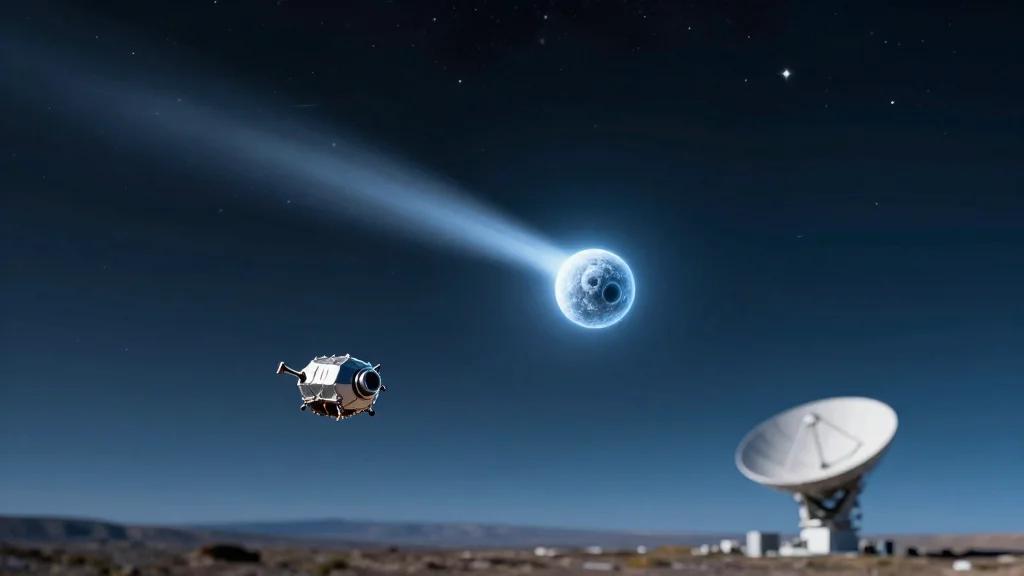
Interstellar Comet 3I/ATLAS Formed in Ultra‑cold Space, Study Finds

Why It Matters
The detection of an extreme deuterium enrichment in 3I/ATLAS provides the first direct evidence that some planetary systems form in environments far colder than the early Solar System. This insight reshapes our understanding of how water—and by extension, the ingredients for life—are distributed across the galaxy. It also validates the use of interstellar objects as natural laboratories for probing the chemistry of distant star‑forming regions, a capability previously limited to remote observations of nebulae. Beyond academic interest, the findings have practical implications for models of planet formation and the delivery of volatiles to terrestrial worlds. If ultra‑cold formation pathways are common, they could affect the isotopic composition of exoplanet atmospheres, influencing the criteria used to assess habitability in future telescopic surveys.
Key Takeaways
- •ALMA measured a D/H ratio in 3I/ATLAS 30‑40× higher than in Solar System comets
- •ESA’s JUICE captured the comet at 64 million km, providing visual confirmation of its trajectory
- •The comet was discovered in July 2025 inside Jupiter’s orbit and is now between Jupiter and Saturn
- •High deuterium enrichment indicates formation in an ultra‑cold molecular cloud (<20 K)
- •Results suggest interstellar objects can serve as probes of distant planetary system chemistry
Pulse Analysis
The 3I/ATLAS discovery arrives at a moment when the astronomical community is eager for tangible chemical data from interstellar interlopers. Previous ISOs offered only dynamical clues; this comet delivers a compositional fingerprint that can be directly linked to formation temperature. Historically, the D/H ratio has been a cornerstone for tracing water’s origin in the Solar System, but extending this metric to extrasolar material bridges a critical gap in comparative planetology.
From a market perspective, the ability to characterize ISOs with facilities like ALMA and JUICE underscores the value of maintaining and expanding high‑resolution spectroscopic infrastructure. Funding agencies may view this success as justification for next‑generation observatories designed to capture fleeting targets, potentially accelerating proposals for dedicated ISO‑tracking satellites. Moreover, the data could inform the design of future sample‑return missions that aim to retrieve material from interstellar sources, a concept that has moved from speculative to plausible.
Looking forward, the scientific payoff hinges on the frequency of such detections. If 3I/ATLAS is not an outlier, a steady stream of chemically diverse ISOs could transform our models of galactic water distribution and the prevalence of life‑supporting environments. The upcoming James Webb observations and the planned Interstellar Probe will be decisive in determining whether the ultra‑cold formation pathway is a common thread or a rare exception in the tapestry of planetary system evolution.
Interstellar comet 3I/ATLAS formed in ultra‑cold space, study finds
Comments
Want to join the conversation?
Loading comments...