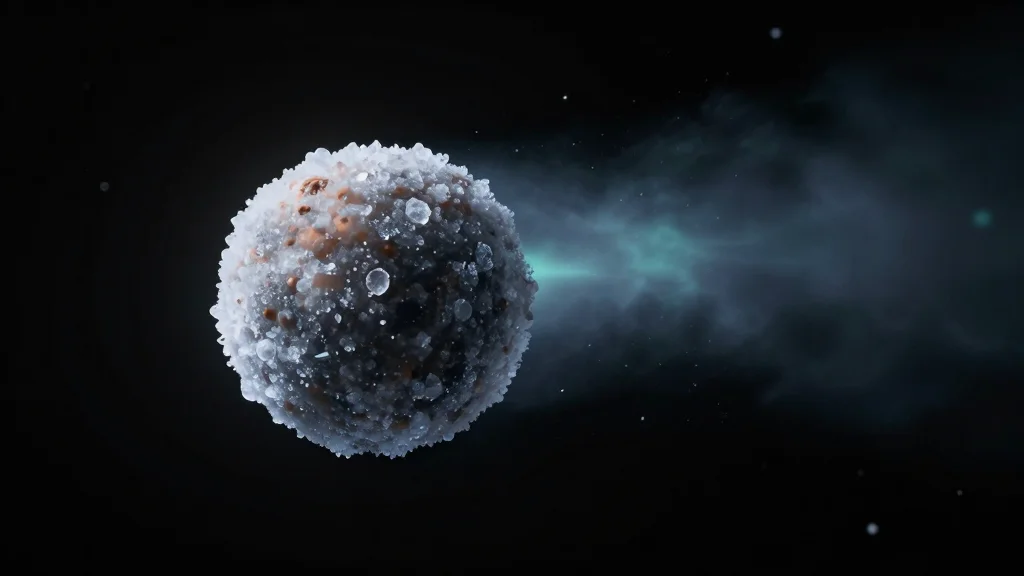
Interstellar Comet 3I/ATLAS Reveals Alien Water with Record-High Deuterium Levels

Why It Matters
Detecting water with an anomalously high D/H ratio in an interstellar comet provides the first concrete chemical link between our solar system and distant planetary systems. It validates the use of ISOs as natural laboratories for probing the conditions of planet formation beyond the Sun, potentially reshaping theories about how water—and by extension, habitability—spreads across the galaxy. Moreover, the result highlights the importance of rapid-response observations, as the fleeting nature of ISOs demands coordinated use of space‑based and ground‑based assets. Beyond planetary science, the discovery informs astrobiology by confirming that water, a key ingredient for life, is a common by‑product of star formation, albeit with diverse isotopic signatures. Understanding this diversity will help refine the criteria used to assess the habitability of exoplanetary systems discovered by upcoming telescopes such as the James Webb Space Telescope and the Extremely Large Telescope.
Key Takeaways
- •Water detected in interstellar comet 3I/ATLAS with D/H ratio 30‑40× higher than solar‑system comets
- •Observations made by Hubble (Nov 30 2025) and ESA JUICE (Nov 5 2025)
- •Lead researcher Luis E. Salazar Manzano emphasizes isotopic measurements as key to formation history
- •Astrobiologist Karen Meech highlights ISOs as physical remnants of other planetary systems
- •Findings may force revision of models for water delivery to terrestrial planets
Pulse Analysis
The 3I/ATLAS water detection arrives at a pivotal moment for planetary science, where the community is transitioning from cataloguing exoplanet demographics to dissecting their chemical make‑up. Historically, isotopic studies of solar‑system comets have been used to trace the provenance of Earth's oceans, but the sample size has been limited to bodies that formed within a single protoplanetary disk. 3I/ATLAS expands that sample to a truly extraterrestrial context, offering a baseline for comparing isotopic reservoirs across the galaxy.
If subsequent ISOs exhibit similarly extreme D/H ratios, it could imply that cold, deuterium‑rich environments are more common than previously thought, suggesting that water delivery to nascent planets may be a universal process, albeit with varying isotopic fingerprints. This would have downstream implications for interpreting the atmospheric spectra of exoplanets; a planet with a high D/H ratio in its water vapor could be flagged as having accreted material from a distant, cold reservoir.
Strategically, the discovery underscores the value of rapid, multi‑instrument coordination. The combined use of Hubble, JUICE, and ground‑based facilities set a new operational template for ISO follow‑up, one that future observatories like the Rubin Observatory will need to emulate at scale. As the detection rate of ISOs climbs, the field may witness a paradigm shift where interstellar chemistry becomes a routine diagnostic tool, bridging planetary formation theory with observational cosmochemistry.
Interstellar comet 3I/ATLAS reveals alien water with record-high deuterium levels
Comments
Want to join the conversation?
Loading comments...