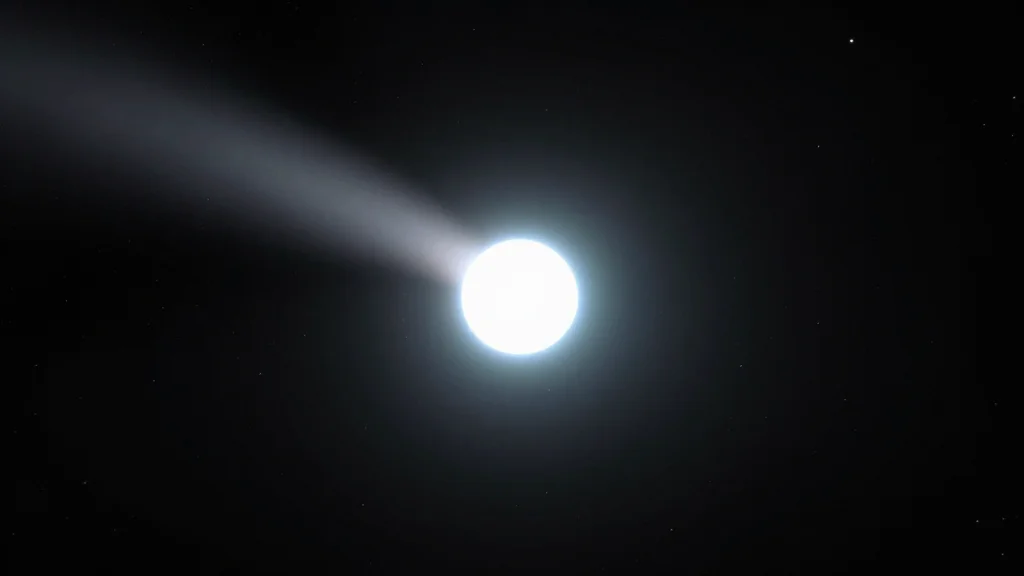
Interstellar Comet Reveals Methane on Its Journey Through Our Solar System
Why It Matters
The discovery proves that organic molecules like methane are common beyond the Sun, reshaping theories of how planetary systems acquire volatiles and informing future interstellar exploration strategies. It also strengthens the business case for investing in deep‑space missions and resource extraction technologies.
Key Takeaways
- •Methane detected in interstellar comet 2I/Borisov via infrared spectroscopy.
- •Abundance roughly 0.5% of water, matching solar‑system comet levels.
- •First direct methane measurement on an object from another star system.
- •Findings suggest organic chemistry is universal across planetary systems.
- •Results boost case for interstellar sample‑return missions and commercial mining.
Pulse Analysis
Interstellar visitors such as 2I/Borisov provide rare, real‑time laboratories for studying material that formed around other stars. When the comet entered the solar system in late 2019, a coordinated campaign of ground‑based and space‑based observatories captured its spectrum across infrared wavelengths. Caltech researchers, leveraging the Infrared Telescope Facility and early data from the James Webb Space Telescope, identified distinct absorption features attributable to methane (CH4). The measurement, reported in a Caltech news release, represents the first unambiguous detection of this simple hydrocarbon on an object of extrasolar origin.
Methane’s presence at roughly half a percent of the water ice inventory mirrors the volatile ratios seen in many Oort‑cloud comets, suggesting that the processes that seed comets with organics are not unique to the Sun’s protoplanetary disk. This finding narrows the gap between solar‑system chemistry and that of distant planetary systems, supporting models where icy planetesimals inherit a universal mix of carbon‑bearing compounds. Moreover, the detection hints that pre‑biotic chemistry may be widespread, offering fresh clues for astrobiologists seeking the building blocks of life beyond Earth.
For the commercial space sector, the result adds weight to arguments for expanding deep‑space exploration and developing interstellar sample‑return capabilities. Investors and policymakers see a clearer pathway to extracting volatile resources—such as methane, a potential fuel for future propulsion systems—from small bodies that travel between stars. As the industry moves toward reusable launch architectures and in‑space manufacturing, data on the composition of exotic comets can guide technology roadmaps and risk assessments, making the case for sustained funding of next‑generation telescopes and mission concepts.
Interstellar Comet Reveals Methane on Its Journey Through Our Solar System
Comments
Want to join the conversation?
Loading comments...