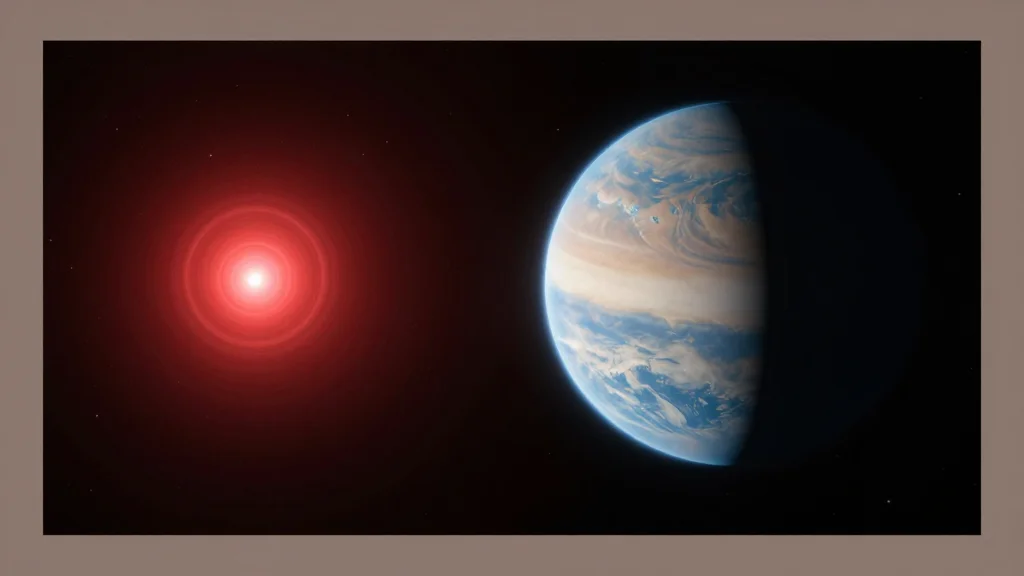
Italian-Brazilian Team Finds Temperate Super‑Earth Ross 318 B 28 Light‑Years Away

Why It Matters
The discovery of Ross 318 b underscores a shift in exoplanet science toward leveraging decades‑long radial‑velocity archives to uncover temperate planets around active M‑dwarfs. Its location within the conservative habitable zone of a nearby star makes it a prime candidate for atmospheric studies, which could inform models of planetary climate and habitability on worlds larger than Earth. Moreover, the finding highlights the importance of international collaboration and the synergy between ground‑based spectrographs and space‑based photometry, setting a template for future searches that aim to populate the nearby habitable‑zone planet inventory. For the broader scientific community, Ross 318 b offers a tangible target for upcoming facilities such as JWST, the Extremely Large Telescope (ELT), and the Thirty Meter Telescope (TMT). Detailed spectroscopic observations could reveal the planet’s atmospheric composition, surface conditions, and potential biosignatures, bridging the gap between detection and the search for life beyond the Solar System. As the nearest temperate super‑Earth, it also provides a benchmark for testing theories of planet formation around low‑mass stars, informing how common such worlds might be in the galaxy.
Key Takeaways
- •Ross 318 b has a minimum mass of 6.21 Earth masses and an estimated radius of ~1.74 Earth radii.
- •The planet orbits its M‑dwarf host every 39.63 days, placing it in the conservative habitable zone.
- •Discovery relied on 15 years of radial‑velocity data from CARMENES (Spain) and HIRES (Hawaii).
- •No transit was detected by TESS, leaving the planet’s radius and atmospheric properties uncertain.
- •Future JWST and ELT observations could measure the planet’s atmosphere and assess habitability.
Pulse Analysis
Ross 318 b arrives at a moment when the exoplanet field is transitioning from a discovery‑driven era to one focused on detailed characterization. The planet’s detection via long‑term radial‑velocity monitoring demonstrates that even in the age of space‑based transit missions, ground‑based spectrographs remain indispensable, especially for active M‑dwarfs where photometric signals are often obscured. This dual‑approach strategy mitigates the bias toward short‑period, large planets that dominate transit catalogs, enriching the sample of temperate, higher‑mass worlds that are more amenable to atmospheric spectroscopy.
The proximity of Ross 318 b—just 28 light‑years—offers a rare opportunity to probe a super‑Earth’s atmosphere with JWST’s near‑infrared instruments. If the planet possesses a substantial atmosphere, spectral features such as water vapor or carbon dioxide could be detectable, providing a direct test of habitability models for planets that sit at the cusp between rocky super‑Earths and mini‑Neptunes. Conversely, a lack of atmospheric signatures would inform theories about atmospheric loss around active red dwarfs, a key uncertainty in assessing the true habitability of M‑dwarf planets.
Strategically, the discovery reinforces the value of sustained, collaborative data archives. As more observatories contribute to long‑baseline RV datasets, the community can expect a steady stream of similar finds, gradually filling the nearby habitable‑zone inventory. This will sharpen target lists for next‑generation telescopes, ensuring that the most promising worlds—like Ross 318 b—receive the observational attention needed to answer the age‑old question of whether life exists elsewhere in the cosmos.
Italian-Brazilian Team Finds Temperate Super‑Earth Ross 318 b 28 Light‑Years Away
Comments
Want to join the conversation?
Loading comments...