James Webb Telescope Detects Most Distant Dormant Black Hole, Invisible in All Wavelengths and Weighing as Much as 6 Billion Suns
Why It Matters
By confirming that massive, inactive black holes existed when the universe was less than a quarter of its current age, the finding reshapes theories of black‑hole growth and their role in shutting down star formation in early galaxies. It also validates a new observational technique that can be applied to future wide‑field surveys.
Key Takeaways
- •JWST identified a dormant black hole 10 billion light‑years away
- •Black hole mass estimated at six billion solar masses
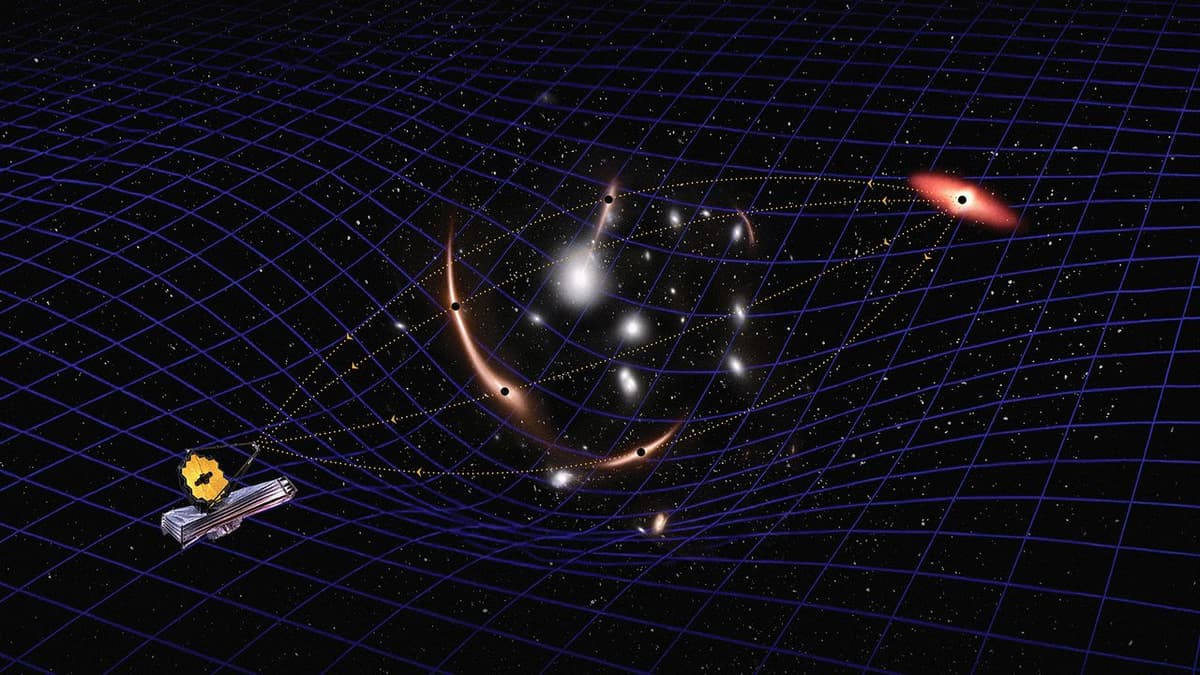
- •Detection relied on gravitational lensing magnifying the host galaxy 30×
- •Findings suggest early black holes can quench star formation in galaxies
- •Euclid and Roman telescopes will broaden early‑universe black‑hole surveys
Pulse Analysis
James Webb’s infrared eyes have pushed the frontier of black‑hole astronomy by revealing a quiescent supermassive object at a redshift that places it over ten billion light‑years away. The breakthrough hinged on a natural cosmic telescope: a foreground galaxy’s gravity stretched and brightened the distant host, allowing astronomers to resolve individual stellar velocities. By adapting a technique normally reserved for nearby galaxies, the team turned a seemingly invisible monster into a measurable mass, demonstrating that JWST can probe the dark hearts of the early universe despite its narrow field of view.
The presence of a six‑billion‑solar‑mass black hole in a galaxy that has already halted star formation forces a rethink of feedback models. Conventional wisdom holds that rapid black‑hole accretion powers luminous quasars, which then expel gas and suppress further star birth. This dormant relic suggests that such quenching can occur swiftly, leaving behind a massive, fuel‑starved core that remains detectable only through its gravitational imprint. Incorporating these data points into cosmological simulations will refine predictions of galaxy‑black‑hole co‑evolution and help resolve why some early galaxies appear surprisingly mature.
Looking ahead, the discovery underscores the need for wide‑area infrared surveys to locate more of these rare objects. The upcoming Euclid mission, with its expansive sky coverage, and the Nancy Grace Roman Space Telescope, slated for launch later this year, will complement JWST’s depth by delivering the statistical sample required for a comprehensive census. Together, they promise to map the population of dormant and active supermassive black holes across cosmic time, sharpening our understanding of the forces that shaped the modern universe.
James Webb telescope detects most distant dormant black hole, invisible in all wavelengths and weighing as much as 6 billion suns
Comments
Want to join the conversation?
Loading comments...