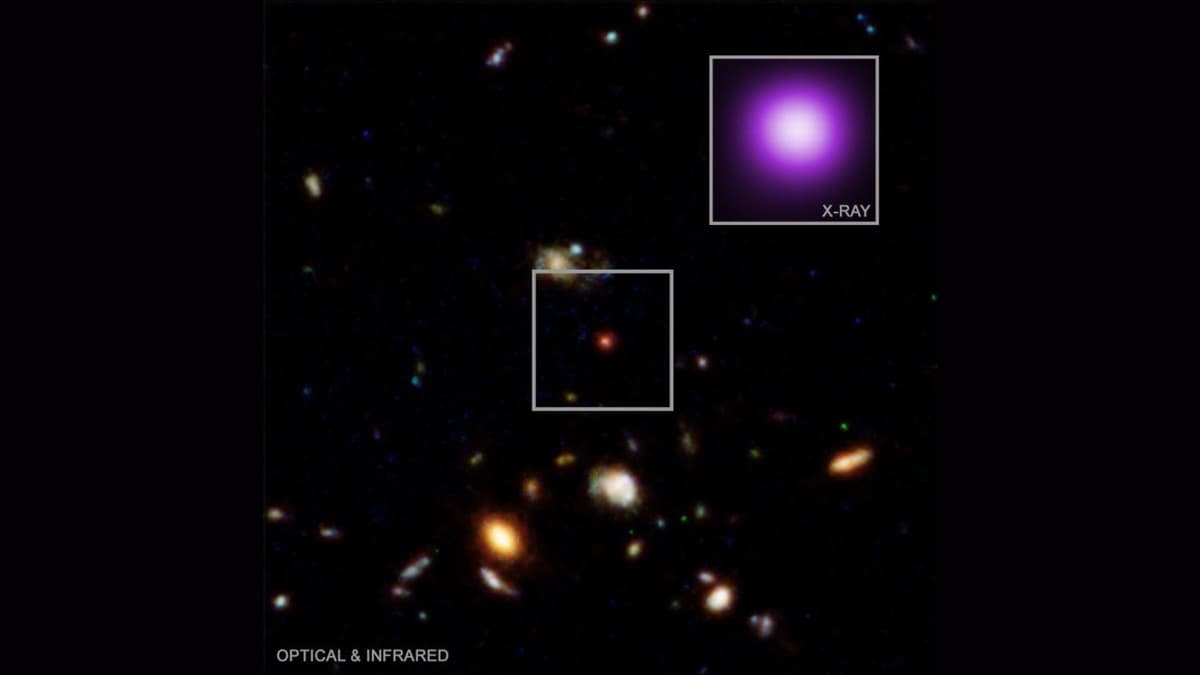
James Webb Telescope Zooms in on a Black Hole that Could Reveal the Truth About 'Little Red Dots'
Why It Matters
The XRD provides the first direct evidence that LRDs may be nascent supermassive black holes, shedding light on how early black holes grew so quickly. This insight reshapes models of galaxy formation and informs future telescope missions targeting rare, dust‑obscured objects.
Key Takeaways
- •JWST and Chandra identified X-ray dot matching little red dot characteristics
- •X-ray emission suggests LRDs are young supermassive black holes with gas cocoons
- •Findings could explain rapid growth of early-universe SMBHs
- •Future Roman Telescope surveys aim to locate rare modern LRD analogues
- •XRD may represent a transitional phase or exotic dust‑obscured black hole
Pulse Analysis
The James Webb Space Telescope’s unprecedented infrared sensitivity has reignited interest in the enigmatic "little red dots"—compact, red‑hued sources first spotted in deep‑field surveys over a decade ago. By cross‑referencing JWST imaging with a decade‑old Chandra X‑ray catalog, researchers uncovered the X‑ray dot (XRD), an object that mirrors LRD morphology while emitting powerful X‑rays. This dual signature challenges the prevailing view that LRDs are X‑ray quiet, prompting a re‑examination of their physical conditions and the role of obscuring gas in early galaxies.
Astrophysicists now interpret the XRD as a young supermassive black hole in a transitional accretion phase. Thick gas cocoons likely veil most of the X‑ray output, but as the black hole voraciously consumes surrounding material, it punches holes in the shroud, allowing X‑rays to escape while preserving the red appearance. This mechanism offers a plausible pathway for the rapid mass buildup observed in quasars less than a billion years after the Big Bang, bridging the gap between nascent black holes and the massive quasars that dominate early‑universe surveys.
Looking ahead, the Nancy Grace Roman Space Telescope will complement JWST by scanning vast sky areas for rare, modern LRD analogues, enabling statistical studies of these fleeting phases. Coupled with next‑generation X‑ray observatories, the combined data will refine models of black‑hole seed formation, feedback processes, and galaxy evolution. The XRD thus serves as a keystone discovery, linking archival data with cutting‑edge observations to unravel a cornerstone mystery of cosmic history.
James Webb telescope zooms in on a black hole that could reveal the truth about 'little red dots'
Comments
Want to join the conversation?
Loading comments...