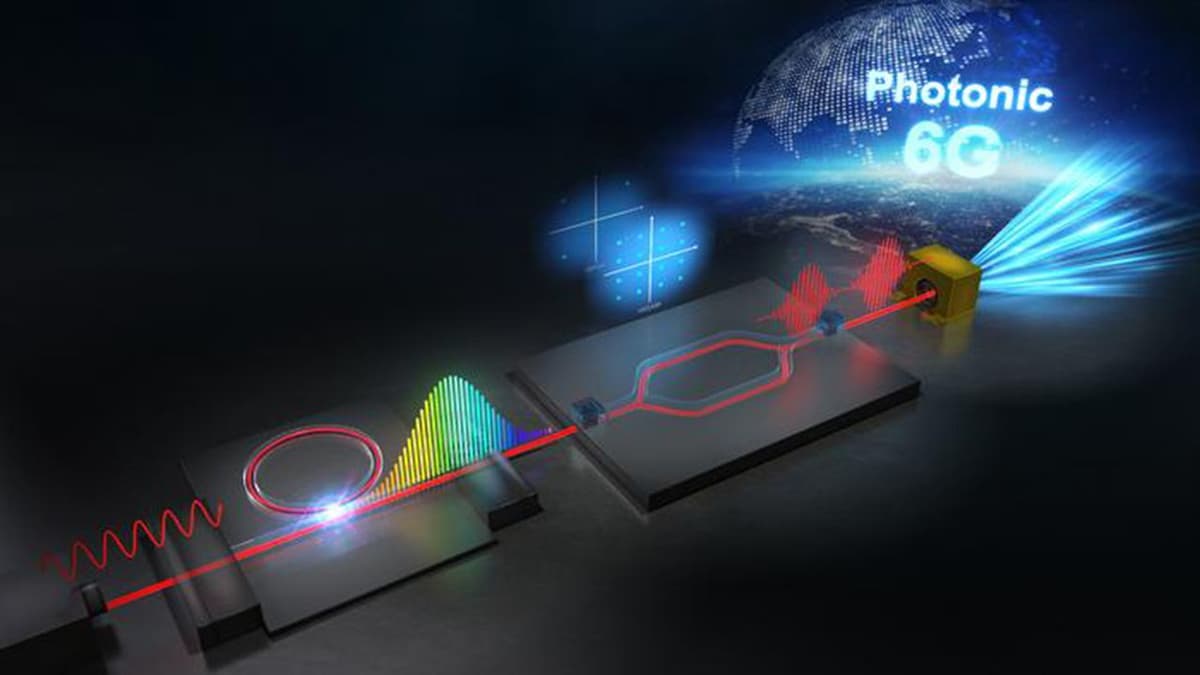
Japan Hits 6G Key Milestone with High-Frequency Speeds Topping 100 Gbps
Why It Matters
The breakthrough shows that compact, stable terahertz sources can support the massive data rates required for 6G, potentially reshaping backhaul architecture and accelerating commercial deployment timelines.
Key Takeaways
- •Researchers achieved 112 Gbps terahertz transmission at 560 GHz band
- •Microcomb‑on‑silicon‑nitride device eliminates bulky optics and alignment
- •Transmitter size reduced to 5 mm, 35× smaller than conventional systems
- •High‑order QPSK and 16QAM modulation enabled ultra‑high data rates
- •Breakthrough paves way for terahertz backhaul, accelerating 6G rollout
Pulse Analysis
The race to 6G is already prompting engineers to look beyond the millimeter‑wave frequencies that power 5G. Terahertz bands above 350 GHz promise unprecedented capacity, but conventional electronic components falter due to power loss and phase‑noise issues. Photonics offers a solution by using light to carry data, yet traditional laser‑based systems are cumbersome and demand precise alignment, limiting their practicality for dense urban deployments. By integrating a microcomb—a chip‑scale photonic frequency ruler—directly onto a silicon‑nitride resonator, Japanese scientists have sidestepped these constraints, delivering a stable, high‑frequency source that can be mass‑produced.
In the laboratory, the team injected‑locked the microcomb to generate two ultra‑stable optical carriers, then employed high‑order modulation formats (QPSK and 16QAM) before photomixing them into a 560 GHz terahertz wave. The resulting link achieved 112 Gbps, surpassing the 100 Gbps threshold that many industry roadmaps consider a benchmark for viable 6G backhaul. Notably, the entire transmitter fits within a 5 mm package—roughly 35 times smaller than earlier microcomb prototypes—while a built‑in temperature‑control loop preserves performance across real‑world thermal swings.
The implications extend far beyond a single data‑rate record. A compact terahertz source could replace costly underground fiber in dense city cores, offering rapid, flexible upgrades as demand spikes. Telecom operators eyeing 2030‑era 6G rollouts can now envision a phased migration: first deploying photonic backhaul to relieve congested fiber, then layering full‑scale 6G access. Challenges remain, including scaling output power and further suppressing phase noise, but the Japanese milestone provides a concrete engineering blueprint that could accelerate the commercial timeline for ultra‑high‑speed wireless networks.
Japan hits 6G key milestone with high-frequency speeds topping 100 Gbps
Comments
Want to join the conversation?
Loading comments...