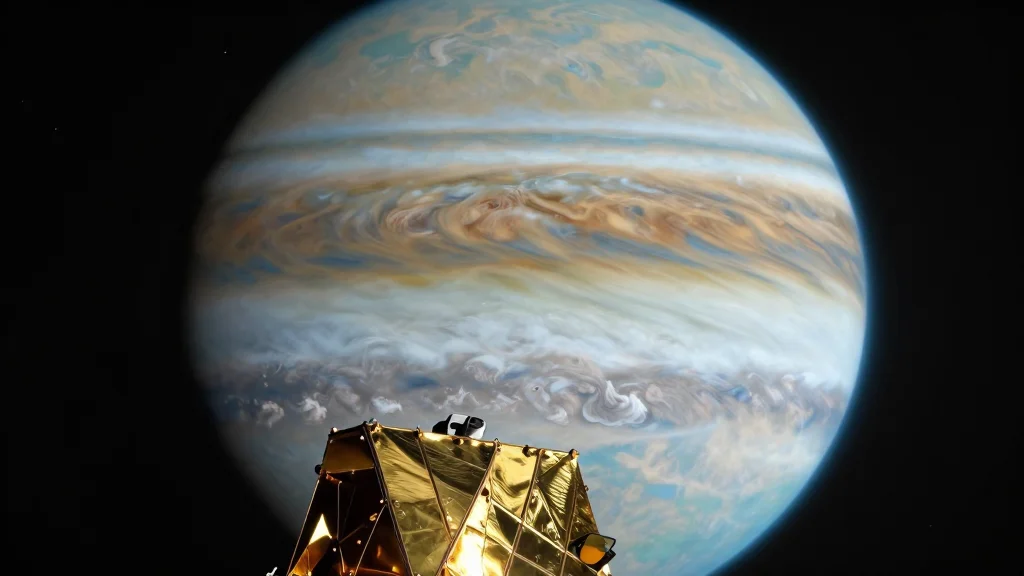
Johns Hopkins Team Clears Cloudy View of Hot Jupiter WASP-94A B with New JWST Method

Why It Matters
The ability to separate cloud‑laden and cloud‑free regions on an exoplanet transforms how scientists infer atmospheric chemistry. Clouds have been a major source of uncertainty, often leading to over‑ or under‑estimates of key gases that inform models of planetary formation and potential habitability. By delivering a clear view of WASP‑94A b’s evening side, the Johns Hopkins team provides a template for more accurate compositional analyses across the exoplanet catalog. Beyond individual planets, the method could recalibrate statistical studies of exoplanet populations. If cloud cycles are common on hot Jupiters, many past atmospheric measurements may need re‑evaluation, potentially reshaping theories about atmospheric dynamics, heat redistribution, and the prevalence of certain chemical species in close‑in giant planets.
Key Takeaways
- •Johns Hopkins researchers used JWST transit spectroscopy to isolate clouds on WASP‑94A b
- •Morning limb shows magnesium silicate clouds; evening limb is clear
- •Clear‑evening spectra reveal Jupiter‑like elemental ratios
- •Technique relies on separate leading‑edge and trailing‑edge measurements
- •Method can be applied to other exoplanets to improve habitability assessments
Pulse Analysis
The cloud‑detecting approach marks a shift from bulk, planet‑averaged spectra to spatially resolved atmospheric diagnostics. Historically, instruments like Hubble offered only integrated signals, forcing astronomers to model clouds as a uniform opacity layer. By exploiting JWST’s high‑resolution, time‑resolved capabilities, Sing’s team effectively turns a single transit into a weather map, a strategy that could become standard as the telescope’s observing program matures.
From a competitive standpoint, the breakthrough gives the U.S. exoplanet community a clear edge in the race to characterize potentially habitable worlds. While European missions such as ARIEL will later target atmospheric composition, JWST’s ability to dissect cloud dynamics now provides a head start in refining target lists for future direct‑imaging observatories like the Habitable Worlds Telescope. The method also underscores the value of interdisciplinary collaboration—combining planetary science, atmospheric physics, and advanced data analysis—to overcome observational barriers.
Looking ahead, the next logical step is to test the technique on smaller, temperate exoplanets where clouds may be composed of water or exotic condensates. Success there would directly impact the search for biosignatures, as clear spectral windows are essential for detecting molecules like oxygen, methane, or phosphine. In short, the fog‑free view of WASP‑94A b is not just a single discovery; it is a proof of concept that could accelerate the entire field toward more reliable, high‑precision exoplanet science.
Johns Hopkins Team Clears Cloudy View of Hot Jupiter WASP-94A b with New JWST Method
Comments
Want to join the conversation?
Loading comments...