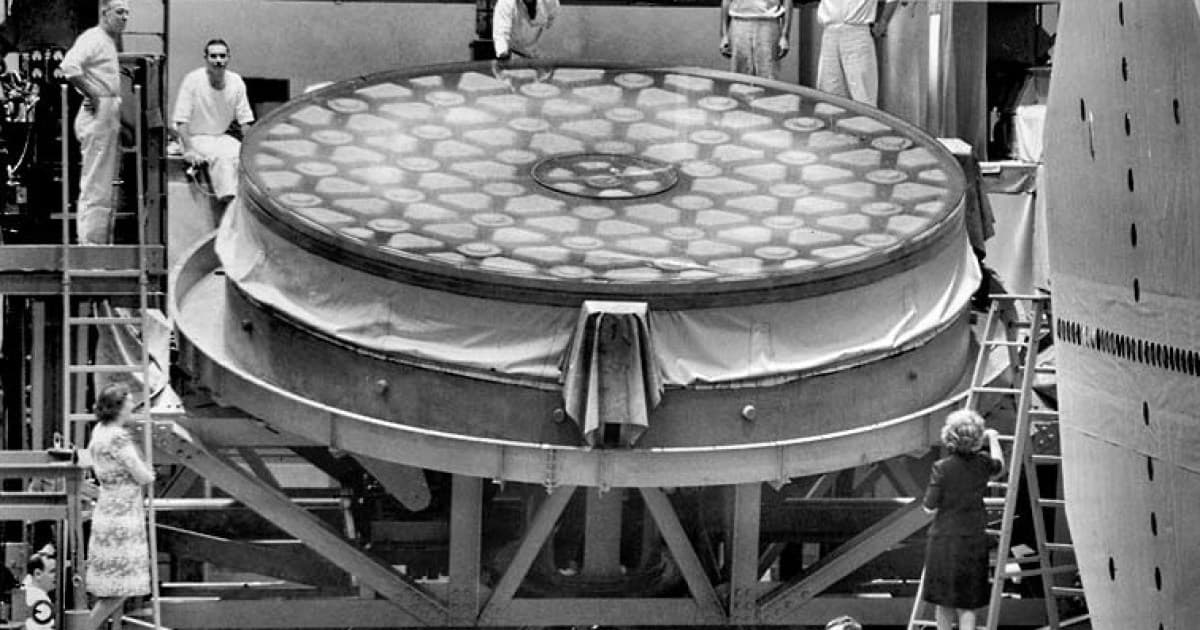
Why It Matters
The Hale Telescope set a new benchmark for optical aperture size, enabling discoveries that reshaped modern astronomy and establishing a template for future large‑scale observatories.
Key Takeaways
- •Hale Telescope's 200‑inch mirror was the largest optical lens of its era
- •Dedicated June 3 1948 at Palomar, honoring astronomer George Ellery Hale
- •First scientific image captured by Edwin Hubble in January 1949
- •Mirror grinding halted during WWII, resumed 1945, showcasing post‑war tech revival
- •Telescope set foundation for modern large‑aperture observatories worldwide
Pulse Analysis
The Hale Telescope’s dedication in 1948 represented a watershed moment for post‑war scientific ambition. After a wartime hiatus, Caltech’s optical shop completed the painstaking grinding of a 200‑inch glass mirror, a feat that required unprecedented precision and resources. George Ellery Hale’s vision—combining rigorous scientific goals with a poetic sense of exploration—drove fundraising and public support, culminating in a ceremony that cemented his legacy despite his death years earlier.
When Edwin Hubble captured the telescope’s first image in early 1949, the astronomical community witnessed the practical payoff of the massive aperture. The instrument’s superior light‑gathering capacity allowed astronomers to resolve faint galaxies, refine distance measurements, and probe stellar populations beyond the reach of earlier telescopes. This breakthrough not only validated the engineering investment but also accelerated the era of observational cosmology, influencing the design of subsequent giants like the 200‑inch Keck telescopes and the 10‑meter Keck I.
Decades later, Palomar’s Hale remains a workhorse for wide‑field surveys and adaptive‑optics experiments, underscoring the long‑term value of large‑scale infrastructure. Its success demonstrated that coordinated public‑private funding, coupled with visionary leadership, can deliver assets that outlive their creators and drive scientific progress for generations. Modern projects—from the James Webb Space Telescope to the upcoming Extremely Large Telescope—draw lessons from Hale’s blend of technical innovation, strategic advocacy, and enduring scientific impact.
June 3, 1948: Hale Telescope dedicated
Comments
Want to join the conversation?
Loading comments...