Why It Matters
The detection validated gravitational‑lensing theory and opened a new method for mapping mass in the universe, a cornerstone for dark‑matter and cosmology research.
Key Takeaways
- •First Einstein ring observed in radio data of MG 1131+0456 (1987)
- •Discovery published in Nature on June 9, 1988, confirming Einstein’s prediction
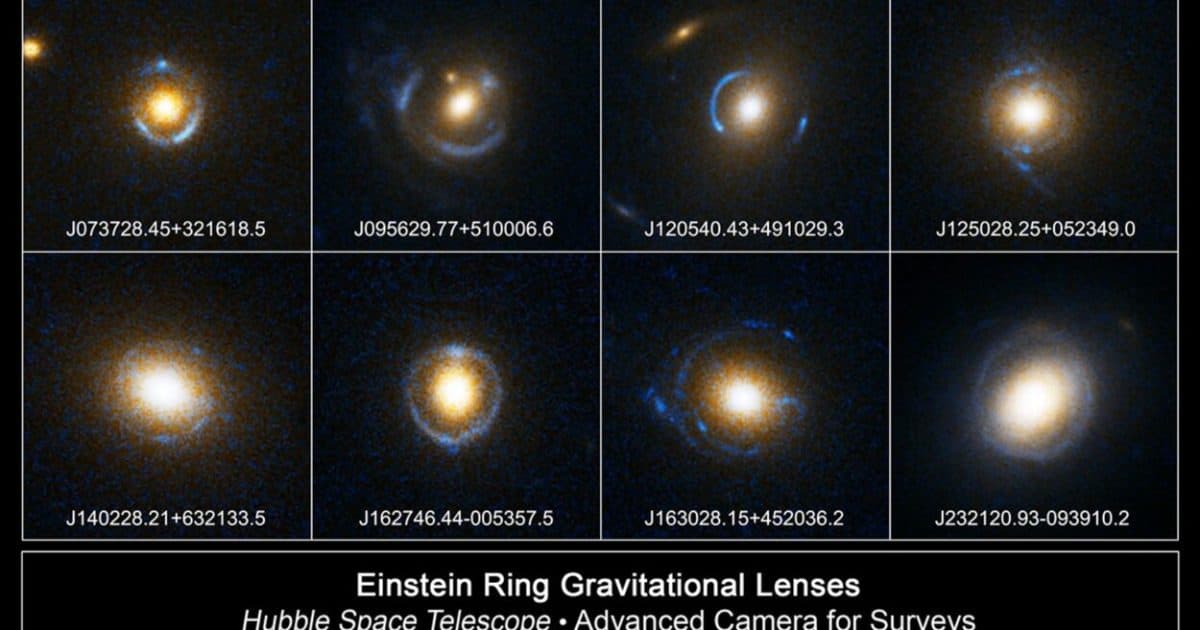
- •Hubble captured eight visual Einstein rings (2004‑2005) for SLACS survey
- •Gravitational lensing studies now probe galaxy mass distribution and dark matter
Pulse Analysis
The concept of an Einstein ring dates back to a 1936 paper by Albert Einstein, who described how light from a distant source would be bent into a perfect circle when a massive foreground object lies directly along the line of sight. It remained a theoretical curiosity until the late 1980s, when Jacqueline Hewitt’s team at MIT, using the Very Large Array, detected the characteristic oval‑shaped radio source MG 1131+0456. Their analysis revealed the first practical example of a complete ring, a breakthrough that cemented gravitational lensing as an observational science.
A decade later, the Hubble Space Telescope provided the visual confirmation that the astronomical community had long awaited. Between August 2004 and March 2005, Hubble captured eight high‑resolution images of Einstein rings as part of the Sloan Lens ACS (SLACS) survey, showcasing the elegant bullseye patterns that arise from precise cosmic alignments. These images not only offered spectacular proof of the phenomenon but also supplied precise measurements of lensing geometry, enabling astronomers to infer the mass profiles of the intervening galaxies with unprecedented accuracy.
Today, Einstein rings are more than a visual curiosity; they are a quantitative probe of the universe’s hidden mass. By modeling the distortion of background light, researchers can map the distribution of dark matter in lensing galaxies, test predictions of General Relativity on galactic scales, and refine estimates of the Hubble constant through time‑delay measurements. As upcoming facilities like the James Webb Space Telescope and the Vera C. Rubin Observatory expand the catalog of lenses, Einstein rings will continue to illuminate the dark corners of cosmology, guiding both theoretical and observational advances.
June 9, 1988: First image of an Einstein ring
Comments
Want to join the conversation?
Loading comments...