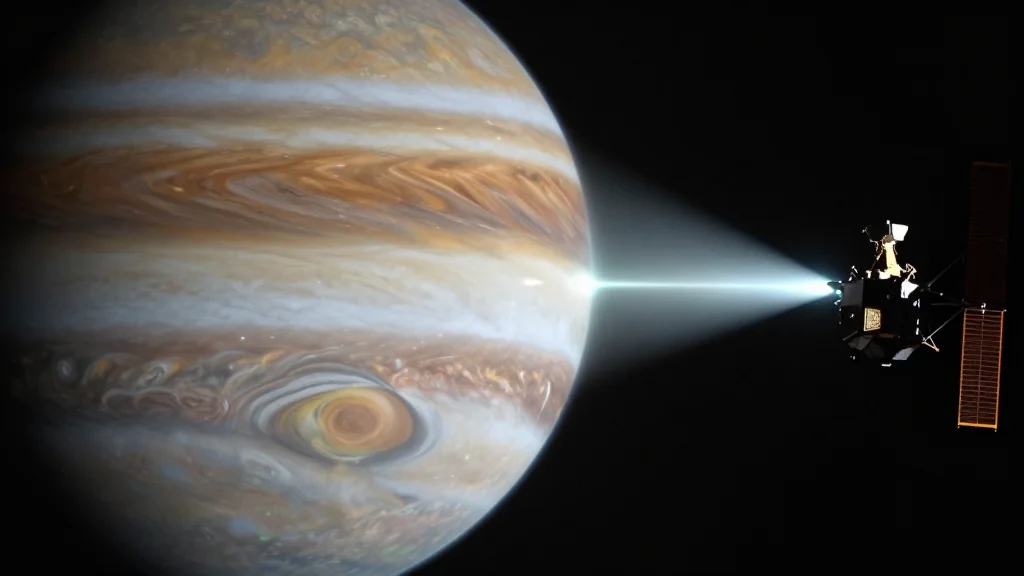
Juno Detects Relativistic Electron Acceleration at Jupiter’s Bow Shock

Why It Matters
The observation of relativistic electrons at Jupiter’s bow shock provides the first in‑situ evidence that planetary foreshocks can serve as efficient particle accelerators. This insight reshapes our understanding of how cosmic rays acquire energy, linking small‑scale plasma turbulence to large‑scale astrophysical phenomena. For space exploration, the results improve models of radiation exposure for spacecraft navigating the harsh environments of giant planets, directly impacting mission planning and crew safety. Beyond the solar system, the scaling law derived from Jupiter’s foreshock offers a benchmark for interpreting high‑energy emissions from distant astrophysical shocks, such as those in supernova remnants or active galactic nuclei. By anchoring theoretical frameworks to concrete planetary data, scientists can better assess the contribution of collisionless shocks to the cosmic‑ray spectrum observed on Earth.
Key Takeaways
- •Juno recorded electrons reaching relativistic speeds at Jupiter’s bow shock, the first such observation in a planetary magnetosphere.
- •Foreshock transients upstream of the shock were identified as the acceleration sites.
- •Researchers derived a scaling law linking foreshock size to maximum particle energy.
- •Findings constrain models of cosmic‑ray generation and inform radiation‑hazard assessments for future missions.
- •Upcoming missions like JUICE and Europa Clipper will test the universality of the mechanism.
Pulse Analysis
The Juno discovery marks a turning point for space‑plasma research, moving the field from theoretical speculation to empirical verification. Historically, collisionless shocks have been implicated in cosmic‑ray acceleration, but direct measurements were limited to Earth’s magnetosphere and interplanetary shocks. Jupiter’s massive magnetosphere, with its extensive bow shock and foreshock region, offers a natural laboratory that scales up the process, allowing scientists to probe the upper limits of particle energization.
From a competitive standpoint, the result underscores the value of long‑duration, multi‑instrument missions like Juno that can capture rare, high‑energy events. As agencies plan the next generation of outer‑planet explorers, the ability to monitor shock dynamics will become a priority, potentially influencing payload selections and orbital designs. The synergy between Juno’s findings and upcoming missions could accelerate the development of unified acceleration models that span planetary, heliospheric, and astrophysical contexts.
Looking ahead, the scaling relationship between foreshock size and particle energy invites a broader comparative study across the solar system. If similar mechanisms are confirmed at Saturn, Uranus or Neptune, the community may establish a universal framework for shock‑driven acceleration. Such a framework would refine predictions of radiation belts, improve space‑weather forecasting, and deepen our grasp of the processes that seed the galaxy with high‑energy particles.
Juno Detects Relativistic Electron Acceleration at Jupiter’s Bow Shock
Comments
Want to join the conversation?
Loading comments...