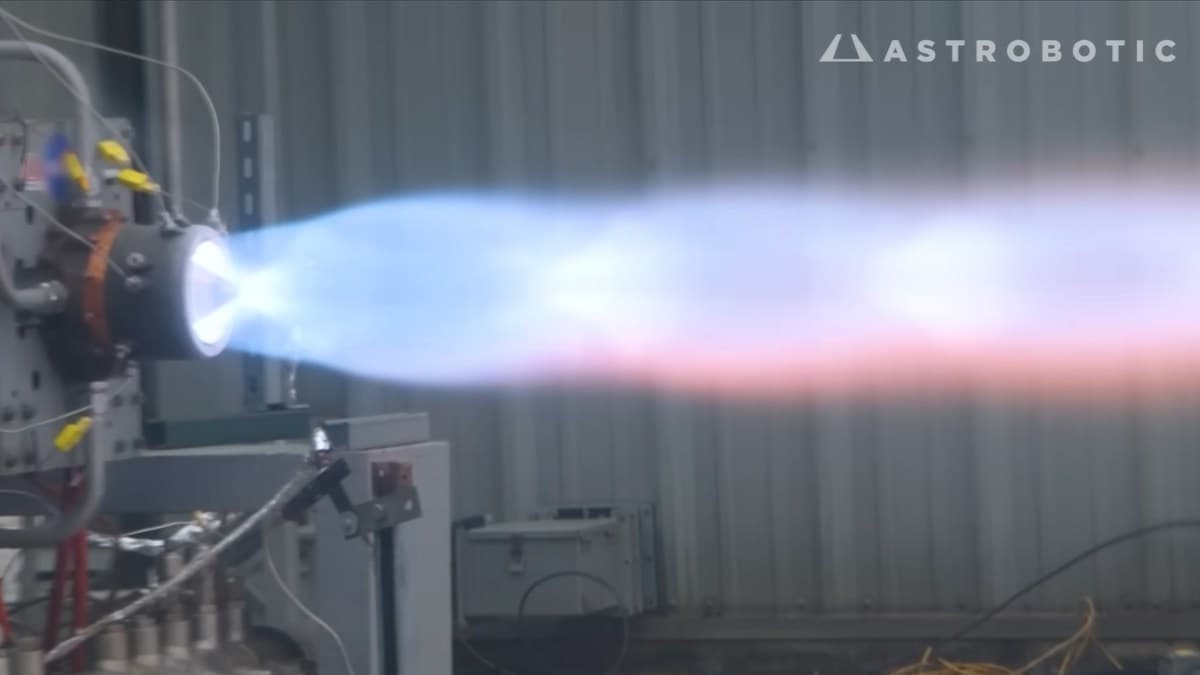
Just Look at the Spiral Exhaust Flame Thrown by This Rotating Detonation Rocket Engine
Companies Mentioned
Why It Matters
The successful long‑duration test proves RDRE technology can provide higher thrust efficiency, potentially reducing launch mass and expanding payload capability for lunar and deep‑space operations.
Key Takeaways
- •Astrobotic's Chakram RDRE produced over 4,000 lb thrust.
- •Engine operated 470 seconds, including a 300‑second record burn.
- •Three supersonic detonation waves circle the engine for rapid combustion.
- •Compact design could boost payload for lunar and cislunar missions.
- •Successful tests at NASA Marshall validate RDRE readiness for spaceflight.
Pulse Analysis
Rotating detonation rocket engines represent a paradigm shift in propulsion, replacing traditional combustion chambers with a series of supersonic detonation waves that travel circumferentially. By igniting fuel in a continuous, self‑sustaining shock front, RDREs achieve higher specific impulse and lower propellant waste than conventional chemical rockets. Astrobotic’s Chakram leverages three synchronized waves, producing a striking spiral exhaust pattern that signals efficient pressure matching and reduced thermal losses—key advantages for missions where every kilogram counts.
The recent test campaign at NASA’s Marshall Space Flight Center validated these theoretical gains under real‑world conditions. Chakram generated more than 4,000 lb of thrust and sustained a 300‑second burn, the longest continuous operation recorded for an RDRE to date. The engine’s 470‑second total runtime without discernible damage demonstrates robustness that addresses long‑standing reliability concerns, positioning the technology as a viable candidate for both launch‑stage thrust augmentation and in‑space propulsion.
Commercial and governmental space actors are closely watching the outcome, as the compact RDRE could be retrofitted onto Astrobotic’s existing product line, including the Xogdor VTOL rocket and lunar landers. Higher thrust efficiency translates directly into increased payload margins for lunar surface deliveries and cislunar transfer vehicles, potentially lowering mission costs and accelerating the cadence of deep‑space exploration. As the industry pushes toward sustainable lunar infrastructure and beyond, RDREs like Chakram may become a cornerstone of next‑generation propulsion architectures.
Just Look at the Spiral Exhaust Flame Thrown by This Rotating Detonation Rocket Engine
Comments
Want to join the conversation?
Loading comments...