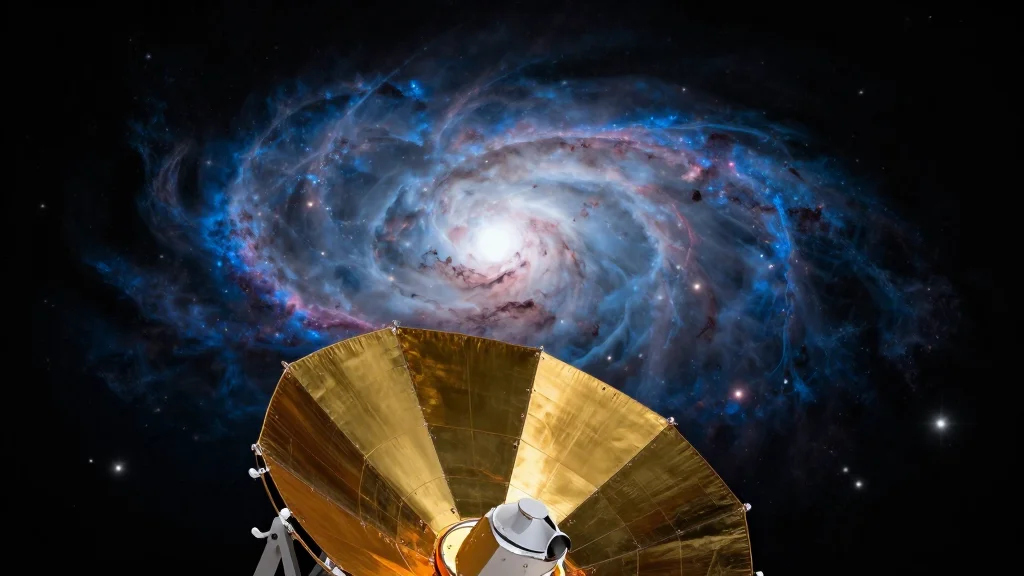
JWST and Hubble Find Massive Star Clusters Emerge Faster
Why It Matters
Accelerated cluster formation reshapes our understanding of how galaxies build their stellar mass, influencing predictions for the early universe and informing future observational strategies.
Key Takeaways
- •JWST and Hubble captured clusters reaching millions of solar masses in ~2 Myr
- •Observed formation rates exceed predictions from standard star‑formation models
- •Rapid cluster growth implies early galaxies assembled stars more efficiently
- •Findings will force revisions to galaxy‑evolution simulations
- •New data guide future JWST deep‑field surveys of distant galaxies
Pulse Analysis
The combined power of JWST’s infrared sensitivity and Hubble’s optical clarity has unveiled a surprising speed in the birth of massive star clusters. By focusing on nearby starburst regions, astronomers recorded clusters amassing up to several million solar masses in just a few million years—far quicker than the tens to hundreds of millions of years traditionally assumed. This rapid assembly hints at a more vigorous star‑formation environment in the early cosmos, where dense gas clouds could collapse under gravity with unprecedented efficiency.
These observations carry profound implications for theoretical astrophysics. Current galaxy‑formation models rely on gradual star‑cluster buildup to explain the distribution of stellar populations across cosmic time. The new data demand a recalibration of feedback mechanisms, such as supernova-driven winds, which may have been less effective at halting cluster growth than previously thought. By integrating these faster formation rates, simulations can better reproduce the observed mass‑to‑light ratios of distant galaxies and refine estimates of the universe’s reionization timeline.
Looking ahead, the discovery sets a clear agenda for future research. JWST’s upcoming deep‑field campaigns will target even more distant, high‑redshift galaxies to test whether this rapid cluster formation was a universal phenomenon or limited to specific environments. Complementary observations from ground‑based observatories, like the Extremely Large Telescope, will provide spectroscopic details on the chemical enrichment of these clusters. Together, these efforts will sharpen our picture of how the first luminous structures shaped the cosmos, offering a richer narrative for both scientists and the public.
JWST and Hubble Find Massive Star Clusters Emerge Faster
Comments
Want to join the conversation?
Loading comments...