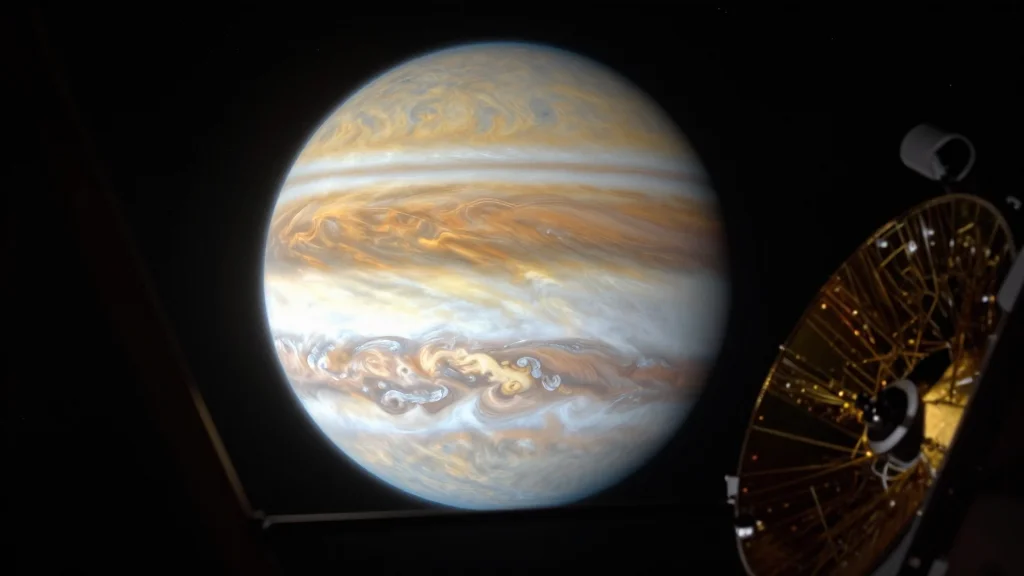
JWST Captures Daily Mineral Cloud Cycle on Hot‑Jupiter WASP‑94Ab

Companies Mentioned

Bloomberg
Why It Matters
Understanding cloud formation on exoplanets is critical because clouds can mask or mimic spectral signatures of gases, leading to misestimates of planetary composition and temperature. The JWST detection of a rapid mineral cloud cycle on WASP‑94Ab provides a concrete benchmark for calibrating atmospheric models, improving the reliability of mass‑radius relationships and chemical inventories across thousands of known exoplanets. Moreover, the ability to differentiate morning and evening limbs demonstrates a new observational lever for probing three‑dimensional weather patterns, a step toward true climate characterization beyond our solar system. The discovery also has broader implications for the search for habitable worlds. If mineral clouds can form and dissipate on timescales of hours on gas giants, similar processes may influence the albedo and surface conditions of rocky exoplanets with thin atmospheres, affecting their potential to retain liquid water. As JWST continues to deliver high‑precision spectra, the methods refined on WASP‑94Ab will become essential tools for assessing atmospheric stability and habitability in the coming decade.
Key Takeaways
- •JWST observed mineral (magnesium silicate) clouds forming on WASP‑94Ab each morning and disappearing by evening.
- •Morning limb shows muted aerosol‑dominated spectrum; evening limb reveals clear water absorption.
- •Study published in Science resolves long‑standing cloud‑induced uncertainties in hot‑Jupiter composition estimates.
- •Findings demand three‑dimensional, time‑dependent atmospheric models for exoplanet climate studies.
- •Future JWST observations will test whether rapid cloud cycles are common among tidally locked exoplanets.
Pulse Analysis
The JWST breakthrough on WASP‑94Ab is more than a curiosity; it signals a paradigm shift in exoplanet atmospheric science. For years, the field has been hamstrung by the “cloud problem,” where hazes obscure key molecular signatures, forcing researchers to rely on indirect inferences. By exploiting the planet’s tidally locked geometry, the team turned a limitation—different limb conditions—into an advantage, effectively performing a natural experiment that isolates atmospheric layers.
Historically, atmospheric models for hot Jupiters have treated clouds as static, globally uniform decks, largely because observational constraints were insufficient to resolve spatial variation. The morning‑evening dichotomy forces modelers to incorporate wind‑driven advection, temperature‑dependent condensation, and rapid vertical mixing. This aligns exoplanet climatology more closely with terrestrial meteorology, where cloud dynamics are central to weather prediction. The result will be a new generation of General Circulation Models (GCMs) that can simulate hour‑scale cloud cycles, improving predictions of phase‑curve observations and secondary eclipses.
Commercially, the ability to characterize exoplanet atmospheres with such fidelity enhances the value proposition of JWST and future missions like the Habitable Worlds Observatory. Investors and agencies can now justify larger allocations toward time‑critical, high‑resolution spectroscopy, knowing that each transit can yield multi‑dimensional climate data. In the longer term, the techniques honed on WASP‑94Ab will be essential for interpreting spectra from smaller, potentially habitable planets, where cloud cover could be the difference between a detectable biosignature and a false negative. The field is poised to move from static snapshots to dynamic weather maps, a transition that will accelerate the search for life beyond Earth.
JWST Captures Daily Mineral Cloud Cycle on Hot‑Jupiter WASP‑94Ab
Comments
Want to join the conversation?
Loading comments...