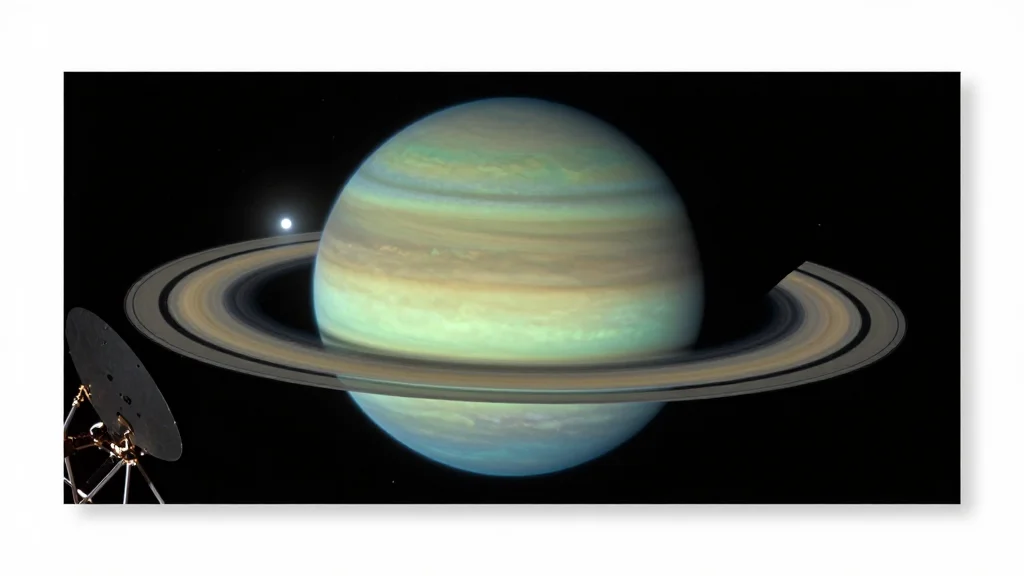
JWST Detects Saturn‑Sized Exoplanet with Earth‑Like Temperature, Methane‑Rich Atmosphere

Why It Matters
The detection of a methane‑rich, temperate giant expands the known diversity of exoplanetary environments, forcing a reevaluation of how giant planets acquire and retain volatile compounds. By bridging the gap between scorching hot Jupiters and icy solar‑system giants, TOI-199b offers a new benchmark for testing theories of planetary migration and atmospheric chemistry. Moreover, the methane signature provides a parallel to Earth's own greenhouse gases, opening avenues for comparative climate studies that could inform models of atmospheric evolution on habitable worlds. Beyond scientific curiosity, the result underscores JWST's capability to probe exoplanet atmospheres with unprecedented precision, setting the stage for future investigations of potentially habitable planets and informing the design of next‑generation telescopes aimed at detecting biosignatures.
Key Takeaways
- •JWST identified TOI-199b, a Saturn‑sized exoplanet with a surface temperature of ~175 °F.
- •Transmission spectroscopy revealed a methane‑dominated atmosphere, the first of its kind for a temperate giant.
- •The planet orbits a star 330+ light‑years away every 100 days, placing it between hot Jupiters and cold solar‑system giants.
- •Findings challenge existing formation models, suggesting migration from colder regions while retaining volatiles.
- •Study led by Renyu Hu (Penn State) and Aaron Bello‑Arufe (JPL) published in The Astronomical Journal.
Pulse Analysis
The TOI-199b discovery arrives at a pivotal moment for exoplanet science, where the community is shifting from cataloguing planets to dissecting their atmospheres. Historically, atmospheric studies have focused on either hot Jupiters—where high temperatures simplify spectral signatures—or smaller, rocky worlds where signals are faint. TOI-199b occupies a middle ground, delivering a strong spectral imprint while residing in a temperature regime that more closely mirrors Earth’s climate extremes. This dual advantage amplifies its scientific value and positions it as a reference point for future temperate‑giant investigations.
From a formation‑theory perspective, the methane richness hints at a cold‑origin scenario. In the core‑accretion model, giant planets forming beyond the snow line accrete icy planetesimals rich in volatiles like methane. If TOI-199b migrated inward, its atmosphere may have preserved these primordial gases, offering a rare glimpse into early planetary chemistry. Competing models that invoke in‑situ formation would need to account for how methane can dominate without the icy reservoir, prompting a reexamination of disk chemistry and migration timelines.
Looking ahead, the result bolsters the case for allocating JWST time to a broader class of temperate giants, which have been under‑observed due to their longer orbital periods and less dramatic transit depths. As the telescope continues to deliver high‑resolution spectra, the exoplanet community can anticipate a cascade of discoveries that will refine atmospheric retrieval techniques, improve climate models for exoplanets, and perhaps even identify chemical pathways relevant to habitability. The TOI-199b study thus not only enriches our planetary inventory but also sharpens the tools needed to answer the ultimate question: how common are Earth‑like conditions beyond our solar system?
JWST Detects Saturn‑Sized Exoplanet with Earth‑Like Temperature, Methane‑Rich Atmosphere
Comments
Want to join the conversation?
Loading comments...