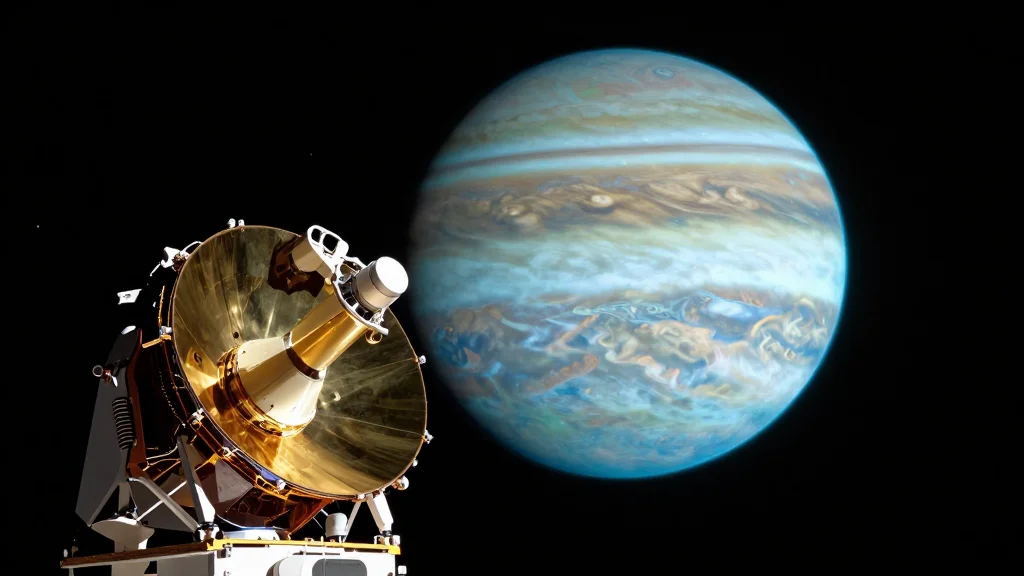
JWST Detects Water‑Ice Clouds on Cold Super‑Jupiter Epsilon Indi Ab

Why It Matters
Detecting water‑ice clouds on a cold super‑Jupiter reshapes our understanding of atmospheric chemistry under low‑temperature, high‑gravity conditions. It provides the first empirical evidence that water‑ice, rather than ammonia, can dominate cloud formation on massive exoplanets, bridging the gap between hot Jupiters and the icy giants of our own Solar System. This insight is crucial for interpreting spectra of smaller, potentially habitable worlds, where cloud composition directly influences surface temperature and habitability assessments. The observation also proves that JWST’s coronagraphic capabilities can extend direct‑imaging science to planets previously thought too faint to study. By expanding the sample of cold, mature exoplanets, astronomers can calibrate evolutionary models that predict how planetary atmospheres change over billions of years, informing both theoretical work and the design of future missions aimed at characterising Earth‑like planets.
Key Takeaways
- •JWST directly imaged Epsilon Indi Ab, a 7.6‑Jupiter‑mass planet 12 ly away.
- •Mid‑infrared spectra reveal patchy water‑ice clouds at 200‑300 K.
- •Weak ammonia signals suggest a shift from ammonia‑ to ice‑driven weather cycles.
- •Findings challenge existing cold‑giant atmospheric models, implying higher metallicity.
- •The result validates JWST’s coronagraph for studying mature, cold exoplanets.
Pulse Analysis
The ice‑cloud detection marks a turning point for exoplanet climatology. Historically, atmospheric models for cold gas giants have extrapolated from Jupiter and Saturn, assuming ammonia‑dominated cloud decks. JWST’s data force a revision: water‑ice can condense at pressures and temperatures previously thought too warm for solid ice, altering radiative transfer and vertical mixing processes. This forces modelers to incorporate a broader range of condensates, which will ripple through predictions for a host of sub‑Jovian planets that sit in the same temperature regime.
From a strategic perspective, the success of JWST’s coronagraph on Epsilon Indi Ab demonstrates that direct imaging can move beyond the niche of ultra‑young, hot planets. The technique now appears viable for a population of older, colder worlds that more closely resemble the Solar System’s giants. This expands the scientific return on JWST’s investment and informs the design of next‑generation observatories such as the Habitable Worlds Telescope, which will need to resolve faint planetary signals in the presence of bright host stars.
Looking ahead, the community will watch how the water‑ice cloud paradigm scales with planetary mass and stellar type. If similar ice‑rich atmospheres are found around lower‑mass planets, the implications for habitability could be profound: high‑altitude ice clouds can reflect stellar radiation, potentially cooling a planet’s surface and extending the traditional habitable zone. JWST’s upcoming campaigns, combined with ground‑based ELT observations, will be pivotal in testing these hypotheses.
JWST Detects Water‑Ice Clouds on Cold Super‑Jupiter Epsilon Indi Ab
Comments
Want to join the conversation?
Loading comments...