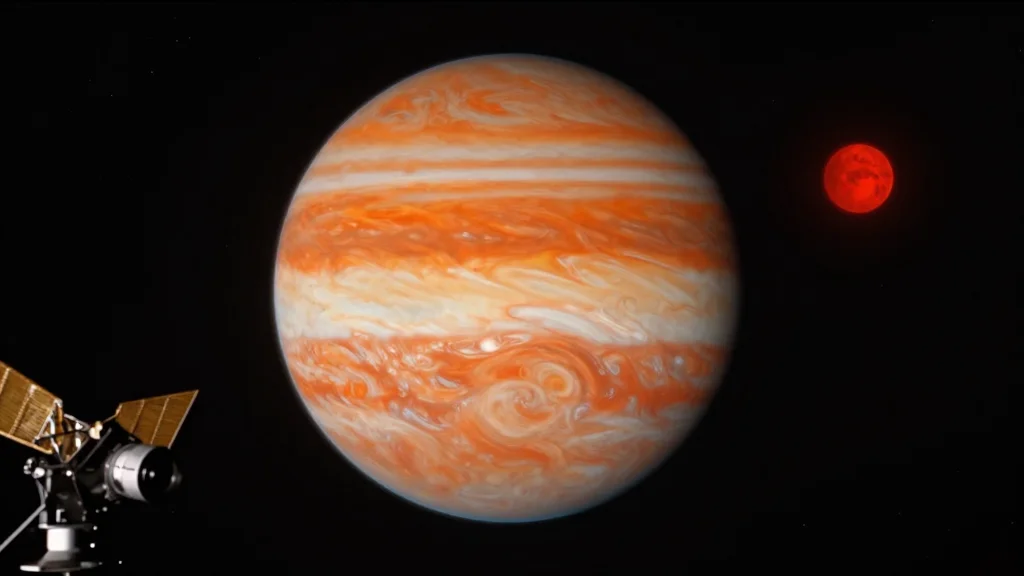
JWST Discovers ‘Forbidden’ Giant Planet with Core Rich in Heavy Elements

Why It Matters
The discovery of TOI‑5205 b forces a reassessment of how giant planets can assemble around low‑mass stars, a scenario previously thought to be rare or impossible. By showing that heavy elements can be sequestered deep within a planet’s core, the finding decouples atmospheric metallicity from bulk composition, challenging the use of atmospheric spectra as a proxy for formation history. Beyond theory, the result expands the catalog of exotic exoplanets that serve as natural laboratories for high‑pressure chemistry and interior dynamics. Understanding such worlds informs models of planet habitability, migration pathways, and the diversity of planetary systems that future missions—like the Habitable Worlds Observatory—will target for biosignature searches.
Key Takeaways
- •JWST identified TOI‑5205 b, a Jupiter‑sized planet orbiting a 0.4 M☉ M‑dwarf.
- •Spectra show an atmosphere depleted in carbon and oxygen, with methane and hydrogen sulfide dominant.
- •Internal composition may be up to 100 times richer in heavy elements than the atmosphere.
- •Finding contradicts core‑accretion models that predict metal‑rich atmospheres for such planets.
- •Study is part of the GEMS Survey, aiming to map giant planets around cool stars.
Pulse Analysis
TOI‑5205 b arrives at a moment when exoplanet science is transitioning from discovery to characterization. JWST’s ability to isolate faint spectral features has turned the telescope into a forensic tool, exposing the internal make‑up of worlds that were previously indistinguishable. Historically, metallicity has been a cornerstone for linking a planet to its birth environment; this case shows that the relationship can break down, implying that planet formation is more stochastic than deterministic.
The broader implication is a potential shift in how astronomers prioritize targets for follow‑up. Planets that appear metal‑poor in their atmospheres may hide massive, metal‑rich cores, making them intriguing candidates for studying interior physics and core‑envelope interactions. This could reshape allocation of JWST time, favoring systems that challenge existing paradigms rather than those that simply confirm them.
Looking ahead, the TOI‑5205 b discovery may spur a new generation of models that incorporate rapid core formation, differential sedimentation, and late‑stage envelope loss. If subsequent GEMS Survey observations reveal a population of similar planets, the field may need to rewrite textbooks on planet formation around M‑dwarfs, with ripple effects on theories of planetary system architecture and the frequency of potentially habitable worlds.
JWST Discovers ‘Forbidden’ Giant Planet with Core Rich in Heavy Elements
Comments
Want to join the conversation?
Loading comments...