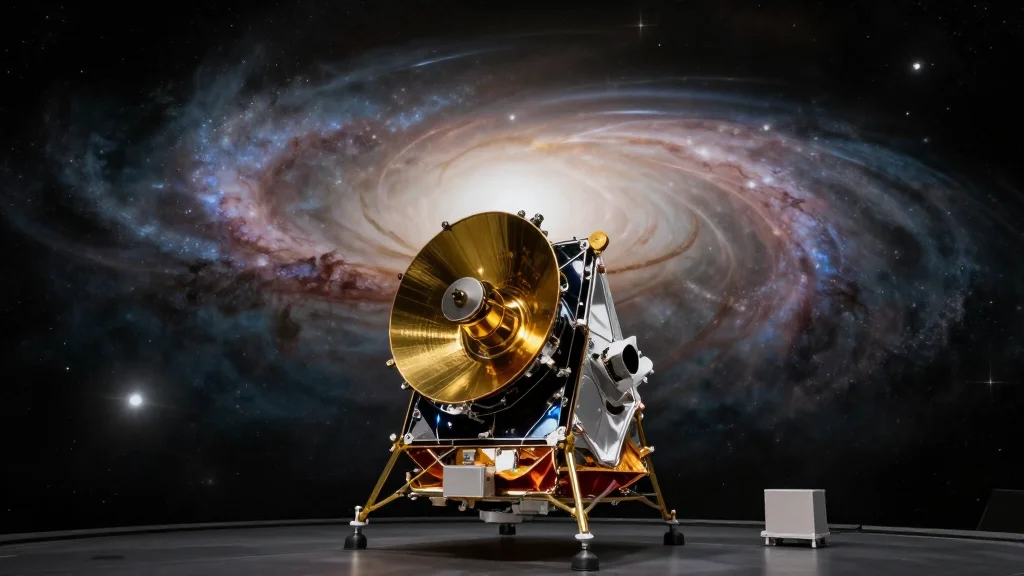
JWST Finds 50‑Million‑Solar‑Mass Black Hole Predating Its Host Galaxy

Why It Matters
Understanding whether supermassive black holes can precede their host galaxies reshapes our picture of the first billion years of cosmic history. A black‑hole‑first scenario implies that gravity wells formed by these objects could have guided the inflow of gas, accelerating star formation and galaxy growth far earlier than current simulations predict. This has downstream effects on models of dark matter distribution, reionization timelines, and the interpretation of deep‑field observations from JWST and upcoming missions like the Nancy Grace Roman Space Telescope. Beyond theoretical astrophysics, the discovery influences the allocation of observational resources. If massive black holes are common in the early universe, astronomers may prioritize lens‑boosted fields and high‑resolution spectroscopy to map their demographics, thereby shaping the scientific agenda and funding decisions for major observatories worldwide.
Key Takeaways
- •JWST identified black hole Abell2744‑QSO1 at ~700 Myr after the Big Bang
- •Mass estimated at ~50 million solar masses, far larger than expected for its epoch
- •Object is a gravitationally lensed “little red dot,” appearing in three images
- •Finding challenges the conventional “galaxies‑first” model of cosmic evolution
- •Follow‑up observations with JWST and ALMA are planned to verify mass and lensing
Pulse Analysis
The Abell2744‑QSO1 discovery arrives at a moment when JWST is redefining the early‑universe narrative. Historically, the hierarchical model posited that dark‑matter halos first gathered gas, forming stars and galaxies, with black holes growing as by‑products. The new mass estimate forces a reconsideration of that sequence, suggesting that under certain conditions—perhaps in regions of unusually low metallicity or high gas inflow—direct‑collapse black holes could reach supermassive scales in a few hundred million years. If such pathways are common, cosmological simulations will need to incorporate more aggressive black‑hole seeding prescriptions, which could ripple through predictions of reionization and large‑scale structure formation.
From a competitive standpoint, the result underscores JWST’s unique capability to resolve faint, lensed sources that were beyond Hubble’s reach. It also highlights the growing synergy between space‑based infrared observatories and ground‑based millimeter arrays like ALMA, which together can disentangle lensing geometry from intrinsic source properties. As the community digests the implications, funding agencies may prioritize programs that target similar lensing clusters, accelerating the hunt for other “over‑massive” black holes. The outcome could set a new benchmark for what constitutes a plausible early‑universe black‑hole formation channel, influencing both theoretical work and the next generation of telescopic surveys.
Looking ahead, the key question is whether Abell2744‑QSO1 is an outlier or the tip of an iceberg. A statistically significant sample of comparable objects would cement the black‑hole‑first hypothesis, prompting a paradigm shift not just in astrophysics but also in related fields such as particle physics, where primordial black holes intersect with dark‑matter theories. The next few years of JWST and ALMA observations will be decisive, potentially rewriting the textbook story of how the first galaxies lit up the cosmos.
JWST Finds 50‑Million‑Solar‑Mass Black Hole Predating Its Host Galaxy
Comments
Want to join the conversation?
Loading comments...