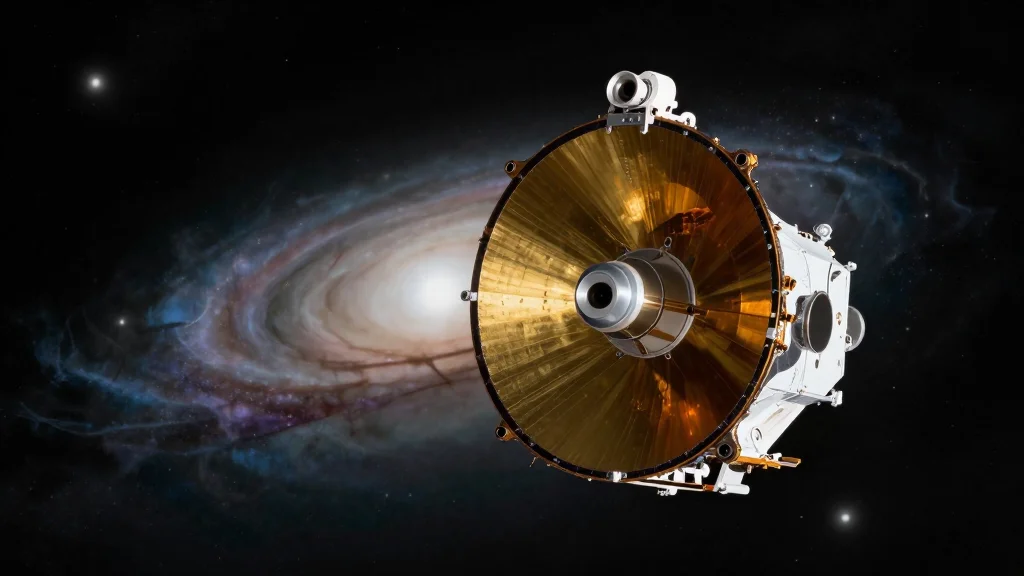
JWST Finds 50‑Million‑Solar‑Mass Black Hole That Predates Its Host Galaxy

Why It Matters
The detection of an over‑massive black hole at a time when the first galaxies were just assembling forces astronomers to reconsider the timeline of cosmic structure formation. If black holes can grow to tens of millions of solar masses within the first 700 million years, they may have contributed significantly to the heating and ionization of the intergalactic medium, altering models of the epoch of re‑ionization. Beyond theoretical implications, the result validates JWST’s capability to probe the faintest, most distant objects with unprecedented clarity. It sets a new benchmark for what is observationally possible, encouraging the scientific community to prioritize deep, lensed field programs that could uncover a hidden population of early massive black holes, thereby reshaping our understanding of the universe’s infancy.
Key Takeaways
- •JWST NIRCam identified a 50‑million‑solar‑mass SMBH in Abell2744‑QSO1, 700 Myr after the Big Bang
- •The black hole appears to predate its host galaxy, challenging standard growth models
- •Direct mass measurement achieved via integrated‑field spectroscopy, a first for such early objects
- •Quotes from Roberto Maiolino and Francesco D’Eugenio highlight the paradigm‑shift nature of the finding
- •Future JWST and ELT observations will test whether this object is an outlier or part of a larger early‑universe population
Pulse Analysis
The JWST discovery of an over‑massive black hole forces a reassessment of the seed‑formation narrative that has dominated cosmology for decades. Historically, models have relied on Population III stellar remnants—black holes of a few tens of solar masses—as the initial seeds, growing slowly through accretion and mergers. The new measurement suggests either that direct‑collapse mechanisms, which produce black holes of 10⁴‑10⁵ M☉, were already in place within the first few hundred million years, or that accretion was far more super‑Eddington than simulations typically allow. Both possibilities imply a more violent, efficient early universe, potentially accelerating galaxy formation and influencing the timing of re‑ionization.
From a methodological standpoint, the result showcases the power of gravitational lensing combined with JWST’s infrared capabilities. By exploiting natural magnification, astronomers can bypass the diffraction limits that have hampered ground‑based observations, opening a window onto the faintest high‑redshift sources. This synergy will likely become a cornerstone of future high‑redshift surveys, especially as the community prepares for the ELT and the Nancy Grace Roman Space Telescope, which will extend the search for similar objects over larger sky areas.
Looking ahead, the key question is whether Abell2744‑QSO1 represents a rare statistical fluke or the tip of an iceberg of early massive black holes. If the latter, cosmological simulations will need to incorporate new physics—perhaps exotic dark‑matter interactions or early‑universe turbulence—to reproduce the observed mass distribution. The next wave of JWST data, coupled with deep spectroscopic follow‑ups, will be decisive in charting this uncharted territory, potentially rewriting the narrative of how the first cosmic behemoths came to dominate their host galaxies.
JWST Finds 50‑Million‑Solar‑Mass Black Hole That Predates Its Host Galaxy
Comments
Want to join the conversation?
Loading comments...