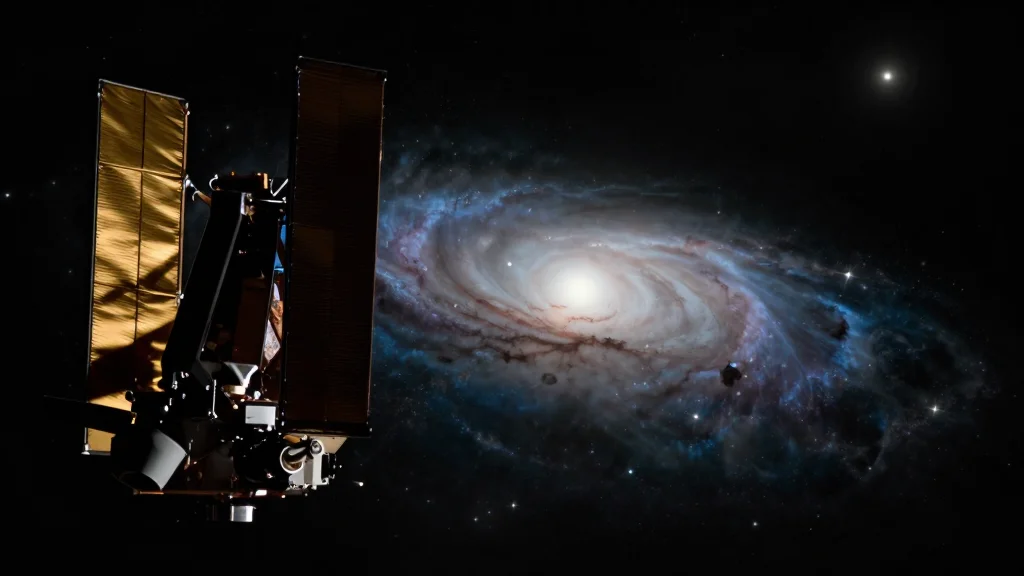
JWST Finds a Stellar Bar in the Early Universe that Breaks All Rules
Why It Matters
The finding forces a revision of galaxy‑evolution theories by showing that turbulent, gas‑rich disks can spawn large stellar bars early, directly influencing star‑formation rates and the rapid emergence of quiescent massive ellipticals.
Key Takeaways
- •JWST/NIRCam reveals 7 kpc stellar bar in galaxy GN20 at z=4.055.
- •Bar formation occurs despite high gas fraction and turbulence in early universe.
- •Bar funnels gas, driving >1,000 M☉/yr nuclear starburst.
- •Findings challenge models that bar growth requires billions of years.
- •May explain rapid quenching of massive elliptical galaxies observed today.
Pulse Analysis
The James Webb Space Telescope’s unprecedented infrared sensitivity is reshaping our view of the early cosmos. By piercing the dense dust that cloaks galaxies like GN20, JWST’s NIRCam and MIRI instruments have exposed structural features previously thought impossible at such epochs. The 7‑kiloparsec stellar bar, a hallmark of mature spiral galaxies, now appears in a system less than two billion years old, suggesting that the mechanisms that sculpt galactic disks operated far more swiftly than standard simulations predict.
Theoretical frameworks have long held that high gas fractions and turbulent dynamics suppress bar instabilities, delaying their emergence until a galaxy’s stellar component dominates. GN20 overturns that assumption: its bar coexists with a gas‑rich, turbulent disk, implying that turbulence itself may catalyze bar formation by redistributing angular momentum. This insight compels modelers to incorporate more nuanced treatments of gas physics, potentially revising timelines for disk settling, bar growth, and the onset of central starbursts in the early universe.
Beyond the astrophysical novelty, the discovery carries weight for the broader narrative of galaxy evolution. Bars act as efficient conduits, channeling gas inward to ignite intense star formation and possibly feed supermassive black holes. In GN20, the bar‑driven inflow likely powers a star‑formation rate exceeding 1,000 solar masses per year, a rate that could rapidly deplete the galaxy’s gas reservoir and precipitate early quenching. This mechanism offers a plausible pathway for the swift emergence of massive, dead elliptical galaxies observed at later times, linking early‑universe dynamics to the present‑day galaxy population. Future JWST and ALMA observations will test whether GN20 is an outlier or the first of many bar‑driven starbursts shaping cosmic history.
JWST finds a stellar bar in the early universe that breaks all rules
Comments
Want to join the conversation?
Loading comments...