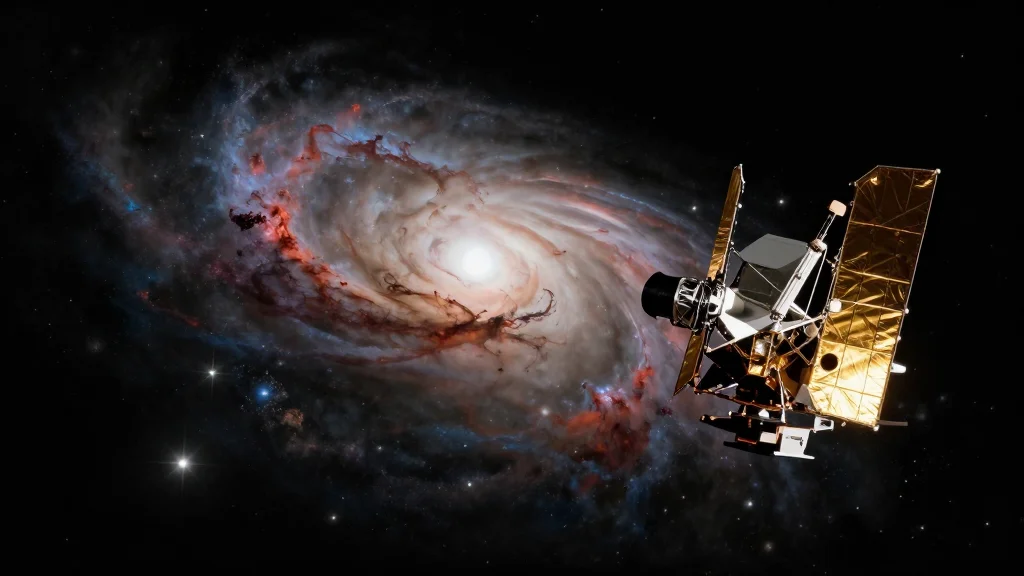
JWST Finds Massive Dusty Galaxy 400 Myr After Big Bang, Defying Models

Why It Matters
The detection of a massive, dust‑laden galaxy only 400 million years after the Big Bang forces a reassessment of how quickly galaxies can assemble and chemically mature. If early dust production is more efficient than current models allow, it could reshape our understanding of star‑formation rates, feedback processes, and the timeline of reionization. Moreover, the finding highlights JWST’s ability to uncover hidden populations that optical telescopes miss, suggesting that the early universe may be more diverse than previously thought. Beyond astrophysics, the result influences related fields such as cosmology and particle physics, where assumptions about the timing of structure formation feed into constraints on dark matter properties and the physics of the early universe. A revision of galaxy‑formation timelines could ripple through these disciplines, prompting new theoretical work and observational campaigns.
Key Takeaways
- •JWST identified galaxy EGS‑z11‑R0 at 400 Myr post‑Big Bang.
- •The galaxy is massive, dust‑rich, and shows carbon signatures.
- •Discovery challenges current models of early galaxy growth.
- •Researchers suggest rapid star formation and early supernovae as explanations.
- •Future JWST spectroscopy will test the prevalence of such dusty early galaxies.
Pulse Analysis
The EGS‑z11‑R0 discovery arrives at a moment when the community is still calibrating JWST’s sensitivity to dust‑obscured sources. Historically, early‑universe surveys relied on ultraviolet‑bright, blue galaxies because dust absorbs UV light, rendering such objects invisible to Hubble‑class telescopes. JWST’s infrared capabilities now expose a hidden side of the epoch of reionization, and this galaxy may be the tip of an iceberg.
If follow‑up observations confirm that EGS‑z11‑R0 is not an extreme outlier, theoretical frameworks will need to incorporate mechanisms for accelerated dust grain growth—perhaps via high‑density star‑forming clumps or efficient supernova dust yields. This could also affect estimates of the ionizing photon budget, as dust can both absorb and re‑emit radiation, altering the balance of reionization models. Competing teams are already racing to adjust semi‑analytic models, and the next JWST data releases will likely trigger a flurry of papers revisiting the timeline of metal enrichment.
Strategically, the finding underscores the importance of deep, wide‑field JWST surveys that prioritize infrared wavelengths. Funding agencies may prioritize programs that target dusty high‑redshift galaxies, and the result could shape the scientific priorities of upcoming missions like the Nancy Grace Roman Space Telescope and the European Athena X‑ray observatory, which will probe complementary aspects of early galaxy evolution. In short, EGS‑z11‑R0 is not just a curiosity; it is a catalyst that could accelerate a paradigm shift in how we view the first billion years of cosmic history.
JWST Finds Massive Dusty Galaxy 400 Myr After Big Bang, Defying Models
Comments
Want to join the conversation?
Loading comments...